1. Introduction: Why Blockchain Matters to Finance in 2026
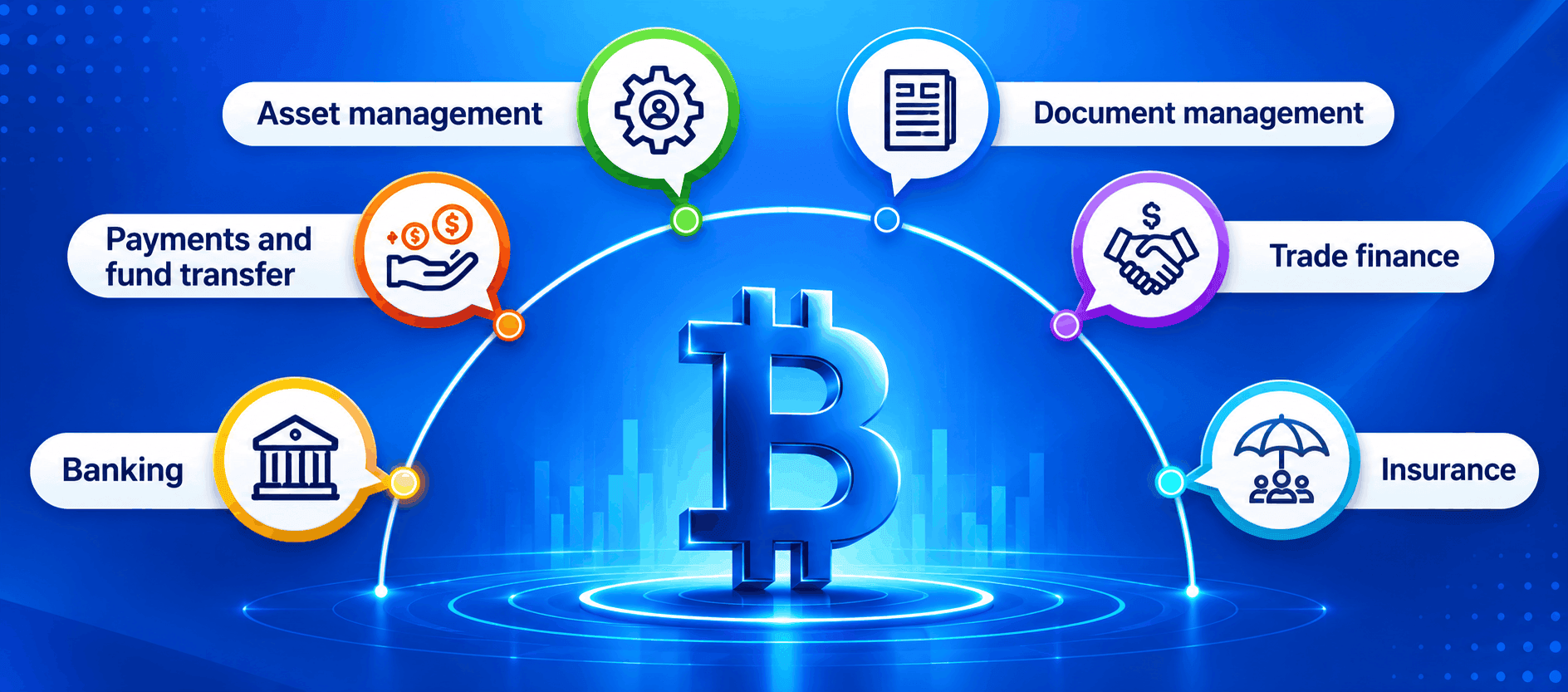
Finance runs on records: who owns what, who owes whom, and whether a payment has really been made. For decades, banks, brokers, custodians and payment companies have each kept their own version of those records and spent a great deal of effort reconciling them. Blockchain offers a different arrangement, in which several organisations share one record that none of them can quietly rewrite. That idea is now being tested in production by banks, asset managers, payment firms and central banks.
This guide is written for founders, product owners, bankers, finance teams and curious readers who want a clear and sourced picture instead of hype. Figures are reported as of the dates shown, and they change quickly, so check current sources before relying on any number for a decision. The sources are listed at the end of the article.
2. Key Takeaways
- Blockchain does three useful jobs in finance: it keeps a shared record of ownership, it lets settlement happen when the trade happens, and it carries programmable rules with the asset
- Stablecoins are the clearest working use case, with supply of roughly $308 to $320 billion in 2026, but almost all of it is dollar-denominated and two issuers hold most of it
- Tokenized real-world assets passed $38 billion in September 2026, yet most are US Treasuries and money-market funds that are created and redeemed far more often than they are traded
- Cross-border payment costs have barely improved, because a large part of the cost sits in data, compliance and currency conversion, not only in the network
- India's retail e-rupee circulation fell in the year to March 2026, which shows that a central bank digital currency needs a real advantage over fast systems such as UPI
- The US GENIUS Act and the EU's MiCA are the two main rulebooks for stablecoins, and the US final rules were still pending in mid-2026
- Before relying on any blockchain financial product, ask who holds the reserves, where the asset can be sold and which law applies if something goes wrong
3. What Blockchain Changes in Finance, and What It Leaves Alone
A blockchain is a shared database that several organisations can write to without trusting a single owner, and that records every change in an order nobody can quietly rewrite. In finance, that property is useful in three specific places. Outside those places, it adds cost without much benefit.
Job one is a shared record of who owns what. Banks, brokers, custodians and clearing houses each keep their own ledger, and a large share of daily back-office work is reconciling those ledgers against one another. A shared ledger replaces several copies of the same fact with one. That is the idea behind tokenized funds and bonds, where the token on the ledger is the record of ownership.
Job two is settlement that happens when the trade happens. On traditional rails, the instruction to pay and the actual movement of money are separate steps, and they can be days apart. On a blockchain, a payment and the asset it buys can move in a single operation, so neither side is exposed while waiting for the other. The same networks also run around the clock, which matters when the two parties sit in different time zones.
Job three is programmable rules. A smart contract is code that carries out agreed conditions automatically: release funds when delivery is confirmed, pay a coupon on a fixed date, or restrict a token to approved buyers. This is where blockchain differs most from simply running a faster database. The rule travels with the asset.
What it does not change is just as important. Blockchain does not remove the need for legal ownership rules, sanctions screening, consumer protection or a trustworthy issuer standing behind a token. A token that claims to represent a US Treasury bill is only as good as the fund that holds the bill. Much of what looks like blockchain adoption in finance is a mix of ledger technology and ordinary regulated institutions, and this guide keeps those two parts separate.
It also helps to distinguish two network types from the start. Public blockchains such as Ethereum and Solana are open networks that anyone can inspect, and BlackRock's tokenized Treasury fund, BUIDL, operates across several public networks. Permissioned blockchains admit only vetted participants. JPMorgan's Kinexys runs on a permissioned network, which suits a bank that needs to control who can take part.
4. Payments and Settlement: Stablecoins and Tokenized Deposits
Stablecoins are the clearest case of blockchain doing real work in finance. They are also still used mostly for dollar transfers and for trading inside the crypto market, not for everyday retail spending.
Trackers disagree slightly because they count different tokens on different dates, so treat any single figure as a snapshot. One aggregator put total supply at $308.0 billion on 13 August 2026, up 14.3 percent over a year and about 99.5 percent dollar-denominated. That was still 4.5 percent below the May peak. The May record was about $322 billion, as reported from CoinDesk data.
The market is concentrated. By early 2026, Tether's USDT and Circle's USDC together held about 93 percent of total supply. Usage is also shifting. A July 2026 market report described a record month for transaction volume, about $1.79 trillion, even though total supply fell roughly $10 billion from the May peak. Volume estimates vary widely with methodology, so the direction matters more than the exact number.
A stablecoin transfer settles in minutes on any day of the week and does not pass through a chain of correspondent banks. For a company paying a supplier abroad, or a freelancer paid from another country, that removes several intermediaries. The trade-offs are real. The user has to trust the issuer's reserves, and the money usually has to be converted back to local currency somewhere, which adds a cost of its own.
Banks are building their own version, called a tokenized deposit. It is an ordinary bank deposit recorded on a blockchain, so it keeps the legal treatment of a deposit rather than becoming a new kind of money. JPMorgan's Kinexys is one of the most widely cited examples. The bank reports more than $4 trillion in cumulative transactions and a daily average above $7 billion across eight currencies, on a permissioned network.
Those numbers come from the bank itself, and the platform is only open to J.P. Morgan's own clients. For scale, J.P. Morgan says its payments business handles about $10 trillion a day. By simple arithmetic on those two bank-reported figures, the blockchain network carries roughly 0.07 percent of that flow. It is growing quickly from a small base, which is a more accurate description than calling it a replacement for existing payment systems. Stablecoins and tokenized deposits are competing designs for the same job, and the regulation section below explains why the legal line between them matters.
5. Tokenization: Putting Real-World Assets on a Blockchain
Tokenization is growing fast, but it is concentrated in the simplest assets. Government debt and money-market funds lead, while the larger prize in private markets has barely started.
Measured by value held on public blockchains, tokenized real-world assets stood at about $38.8 billion on 15 September 2026, according to RWA.xyz data. Estimates differ by methodology, and one 2026 research report puts the range at roughly $31 billion to $38 billion. The growth is steep. A year-end review from Securitize said the sector excluding stablecoins grew from about $5.5 billion to $18.2 billion during 2025.
| Asset Category | Approx. Value on Chain (15 Sep 2026) |
|---|---|
| Tokenized US Treasuries | $15.65 billion |
| Tokenized private credit | $7.96 billion |
| Tokenized commodities | $4.85 billion |
| Tokenized stocks | $2.92 billion |
The figures above come from RWA.xyz data as reported by Eco. Tokenized real estate is smaller than any of these categories, and the rows do not add up to the total.
US Treasury bills are liquid, standardized and legally simple, so they were the easiest asset to wrap in a token. Researchers at Stobox describe the result bluntly: the market has tokenized the assets that were trivial to tokenize. Real estate, private equity and mid-sized company shares are worth far more in total, but they need legal structuring, investor checks and ongoing administration that a Treasury bill does not.
For investors, the practical gains are these:
- Round-the-clock transfer: a tokenized fund can move on a weekend, which a conventional fund cannot
- Use as collateral: in November 2025, VanEck's tokenized Treasury fund was accepted as collateral on the Aave lending protocol, an example of a traditional product being used inside on-chain markets
- Smaller minimums: fractional tokens can in principle lower the entry size for assets that normally require large tickets
The most useful caveat in current research is about trading. Most tokenized credit and Treasury products still mint and redeem rather than trade, because market makers are reluctant to quote assets with quarterly valuations. A token that is easy to transfer is not the same as an asset that is easy to sell at a fair price. Anyone evaluating a tokenized product should ask who will buy it back, and on what terms, before looking at the technology.
6. Cross-Border Payments: Promise and Reality
Sending money abroad is the use case most often used to sell blockchain, and the one where the evidence is most uneven. The technology can shorten the path a payment takes, but the cost of a payment depends on more than the path.
In 2020 the G20 and the Financial Stability Board set targets for cross-border payments to be met by the end of 2027. For retail payments, the global average cost should be no more than 1 percent, with no corridor above 3 percent. The same programme aims for 75 percent of payments to arrive within an hour and for more than 90 percent of people to have access to an electronic remittance option.
Progress has been slow. The FSB's October 2025 progress report concluded that the 2027 targets were unlikely to be met at the global level. In that analysis, the average cost of sending $1,000 person to person was about 2.6 percent in 2025, unchanged from 2023, while payments from individuals to businesses edged down from 2.0 to 1.9 percent.
Remittances to families are costlier still. The World Bank's Remittance Prices Worldwide benchmark put the average cost of a consumer remittance at 6.36 percent in its third-quarter 2025 report. The UN development goal is 3 percent for a $200 transfer by 2030, so the current average is roughly twice the target.
Traditional international payments often pass through several banks, and institutions frequently pre-fund accounts abroad so they can pay out quickly. Each step adds time and fees. A transfer over a shared ledger, or in a stablecoin, can cut the number of hops and settle at any hour. That is the strongest argument for the technology in this area, and it is the reason both banks and payment firms are testing it.
The limits are equally clear. The G20 roadmap treats cost as a problem of frictions behind the payment, and its own summary links lower cost to better data quality, automation and interoperability across the system. A faster ledger does not harmonize those local rules, and it does not remove foreign exchange spreads, compliance checks or the cost of getting cash in and out at each end. A stablecoin payment that is cheap on the network can still be expensive once both conversions are counted.
The practical conclusion is to compare total cost, delivered amount and delivery time for the specific corridor, rather than assuming that any blockchain route is cheaper. In some corridors it will be. In others, a well-run conventional or local instant-payment route will beat it.
7. How Web Squalix Works in Blockchain and Fintech
Web Squalix is an IT services company that works across the full range of software and technology services, from websites and mobile apps to backend systems, integrations, UI and UX design, custom software and AI-supported features. Blockchain and fintech projects are one area of that work. We launched our website in June 2026, and we say so openly: we are a newer company, and we do not claim a client list, awards or a fintech track record that we cannot document. What we can do is explain how we approach this kind of project and what we would recommend.
For us, blockchain is a tool, not the starting point. The first conversation with a fintech team is about the problem. Who are the users? Which regulations apply? Does the product genuinely need a shared ledger, or would a conventional database and payment integration do the job better and cost less? As this guide has shown, many payment problems, such as everyday domestic transfers in India, are already well served by existing systems. When that is the case, we say so instead of selling a blockchain build.
Where a blockchain does fit, these are the areas in which we can build and support software for fintech and blockchain teams:
- Discovery and scoping: a written scope, a list of assumptions, user roles and the compliance questions your legal advisers need to answer, agreed before development starts
- Web and mobile applications: customer-facing apps, dashboards, wallet interfaces, onboarding flows and integrations with third-party identity-verification services
- Backend and API development: the services that connect your product to banks, payment providers, exchanges and blockchain networks, including transaction records, reconciliation and reporting
- Smart contract and blockchain integration: building or integrating smart contracts for uses such as tokenized products and programmable payments, and connecting applications to public or permissioned networks
- Payment and stablecoin integration: wiring checkout, payouts or treasury tools to stablecoin or conventional payment rails, with conversion costs and fees shown to the user
- UI and UX design: clear screens for risk disclosures, transaction confirmations and error messages, which matter more when a mistaken transfer is hard to reverse
- Security and quality assurance: code review, functional and security testing, secure development practices and planning for an independent audit of any contract that holds value
- AI-supported features: tools such as document processing and support assistants, built with a plan to test accuracy and protect user data
- Maintenance and support: monitoring, updates, dependency and security patches, and a roadmap of improvements after launch
A typical engagement starts with a short paid discovery phase, followed by a written scope and a small first release or pilot, and then iteration based on real use. We agree in writing that you own the source code, designs and cloud accounts, and we provide documentation at handover so you are not dependent on us after launch.
It is equally important to state what we do not do. We build software. Licensing, legal structuring, tax treatment and regulatory approvals, including questions under the GENIUS Act, MiCA or Reserve Bank of India rules, are matters for you and your qualified legal and compliance advisers, and we build to the requirements they set.
We believe we are a good fit for startups testing a payments or tokenization idea, small and mid-sized businesses that want custom financial tools, and teams that prefer to speak directly with the engineers. Large banks that need multi-year programmes with heavy governance are usually better served by established global firms, and we would tell you that in a first conversation. To discuss a project, use the contact page on this website, email sales@squalix.com or message us on WhatsApp at +91 9646395900. Share your goals, timeline and budget range, and we will respond with questions and an honest view of scope.
8. Central Bank Digital Currencies: What India's E-Rupee Shows
A central bank digital currency, or CBDC, is a digital form of a country's own currency issued directly by its central bank. It is different from a stablecoin, which a private company issues, and different from a bank deposit. India's digital rupee, the e-rupee, is a useful case study because it shows both the ambition and the difficulty.
The Reserve Bank of India began wholesale and retail pilots in late 2022. According to RBI data reported in May 2026, retail e-rupee in circulation was ₹771.66 crore on 31 March 2026, down from ₹1,016.46 crore a year earlier, a fall of about 24 percent. Wholesale e-rupee circulation was nil at both dates. In July 2026, the RBI governor said the pilot had reached 12 million users and 175 million transactions in total.
That is small next to UPI, which clears billions of transactions a month. For a domestic payment, UPI already gives Indian users an instant, low-friction option, so a retail CBDC has little speed advantage to offer.
The RBI's plans for 2026-27 shift the focus away from everyday spending. The central bank said it would explore bilateral and multilateral cross-border CBDC pilots, along with programmable money and asset tokenisation. It has also extended pilots into government subsidy schemes, started a tokenised credit deposit trial, and joined the BIS-led cross-border projects Rialto and Mandala.
Programmability is the idea to watch. A subsidy paid as a digital token can be limited to approved purchases, such as food from registered shops, which is hard to do with ordinary cash transfers. Whether that proves more useful than existing direct benefit transfers is still an open question. The broader lesson applies well beyond India: a CBDC does not succeed just by existing. It has to offer something that existing payment systems cannot, and for most countries with fast domestic payment rails, that something is likely to be cross-border settlement and conditional payments.
9. Regulation: The Rules Are Arriving, Unevenly
Blockchain in finance depends less on technology than on law. Two frameworks do most to shape the market today: the European Union's MiCA and the United States' GENIUS Act. Both focus first on stablecoins.
| Area | GENIUS Act (United States) | MiCA (European Union) |
|---|---|---|
| Legal basis | Public Law 119-27, signed 18 July 2025 | Regulation (EU) 2023/1114, in force 29 June 2023 |
| Scope | Payment stablecoins | Stablecoins and wider crypto-asset services |
| Stablecoin rules apply from | Earlier of 18 January 2027 or 120 days after final rules | 30 June 2024 |
| Other crypto services apply from | Not covered by this law | 30 December 2024 |
| Core requirements | One-to-one reserves, monthly public disclosure, anti-money-laundering duties | Reserve rules, white paper disclosure, issuer authorisation |
In the United States, the GENIUS Act became law on 18 July 2025 after passing the Senate 68 to 30 and the House 308 to 122. It requires one-to-one reserve backing, monthly public disclosures and full Bank Secrecy Act coverage for permitted issuers. The main framework takes effect on the earlier of 18 January 2027 or 120 days after final implementing rules, and as of June 2026 implementation was still at the proposed-rule stage. Treasury, the banking regulators and FinCEN had each published proposals, including a joint FinCEN and OFAC proposal on anti-money-laundering and sanctions in April 2026. A July 2026 market report summarized the position as one year of the law with no final rules. Readers should check the current status before making compliance decisions.
In the European Union, MiCA applies across all member states without national transposition. Its stablecoin provisions began on 30 June 2024, and the remaining provisions applied from 30 December 2024. A provider authorised in one member state can offer services across the EU under a single passport. Member states were allowed to set transitional periods for existing providers, so the practical timetable differs by country.
Clear rules change who can participate. Banks, payment firms and corporate treasurers generally need defined reserve, disclosure and licensing standards before they commit to a new settlement instrument. The tokenized-deposit approach described earlier also sits more comfortably within existing banking supervision, while stablecoin issuers need their own authorisation regimes.
10. Risks and Limits That Remain
The strongest case for blockchain in finance is also the one that admits its weaknesses. The risks below are the ones most likely to affect real users and institutions over the next few years.
- Issuer and reserve risk: a stablecoin is only as safe as the assets behind it and the company managing them. With two issuers holding about 93 percent of the market, a problem at one of them would reach far beyond that company. Reserve rules in the GENIUS Act and MiCA are designed to reduce this risk, but they are still being put into practice
- Liquidity risk in tokenized assets: many tokenized products can be created and redeemed but rarely trade, so investors may find that the exit is slower or costlier than the on-screen price suggests
- Self-reported numbers: much of the headline data, including JPMorgan's Kinexys volumes, comes from the companies selling the service, and independent measurement is thinner than the volume of press coverage suggests
- Regulatory timing: the US stablecoin law is still waiting on final rules, and rules differ between countries, so a product that is compliant in one jurisdiction may not be allowed in another
- Technical and operational risk: smart contracts can contain errors, wallets can be lost or compromised, and a mistaken on-chain transfer is often hard to reverse. Banks manage this with permissioned systems and controls, but individual users carry more of the responsibility themselves
- Adoption risk: technology does not guarantee use. India's retail e-rupee, for example, saw circulation fall in the year to March 2026 despite a government-backed rollout
None of these risks is a reason to dismiss the technology. They are reasons to ask specific questions before relying on it: who holds the reserves, who audits them, where can the asset be sold, and which law applies if something goes wrong.
11. What This Means for Banks, Businesses and Individual Users
The evidence so far points to a practical pattern: blockchain works best where many parties need to agree on one record, or where settlement delays are costly. It works less well where existing systems are already fast and cheap. The suggestions below follow from that pattern.
For banks and financial institutions:
- Start with problems that involve reconciliation or settlement delay, such as collateral movement, fund distribution and cross-border treasury payments, rather than broad rebuilds
- Compare permissioned and public networks on control, compliance and reach, and expect to use both
- Track the final GENIUS Act rules and MiCA national transition timetables, since they will decide who may issue and distribute tokens
For businesses that pay or get paid across borders:
- Compare total delivered cost and arrival time for each corridor, including conversion at both ends, rather than the network fee alone
- Test with small volumes first, and ask any stablecoin provider for current reserve disclosures and details of its regulatory status
- Ask an accountant how the payment will be recorded and taxed in each country involved
For individuals:
- Treat stablecoins mainly as a payment tool, because their value tracks a currency and they are not insured savings accounts
- Before buying a tokenized fund, read the redemption terms and find out who will buy the token back
- Use providers that are licensed in your country, and keep in mind that mistakes on a blockchain are difficult to undo
This article is general information, not financial, legal or tax advice. Rules and market figures change, so check current sources or consult a qualified professional before acting.
12. Conclusion: Use Blockchain Where It Fits
Blockchain is changing parts of finance in measurable ways. Stablecoins move value around the clock, banks are testing tokenized deposits, asset managers are putting funds on chain, and regulators in the United States and Europe are writing rules for issuers. At the same time, costs for cross-border payments have barely fallen, most tokenized assets are hard to trade and India's retail digital rupee has shrunk instead of growing.
The honest conclusion is that blockchain is a specific tool for specific jobs: shared records, faster settlement and programmable rules. It does not replace banks, remove regulation or make every payment cheaper. If you are planning a fintech or blockchain product, start with the problem, check whether the technology is really needed, and involve legal and compliance advisers early. If you would like to talk through a project with us, get in touch through this website and share your requirements.

Manpreet drives the company’s vision, strategy, and growth, building strong teams and partnerships while helping clients turn ambitious ideas into innovative, scalable digital solutions.