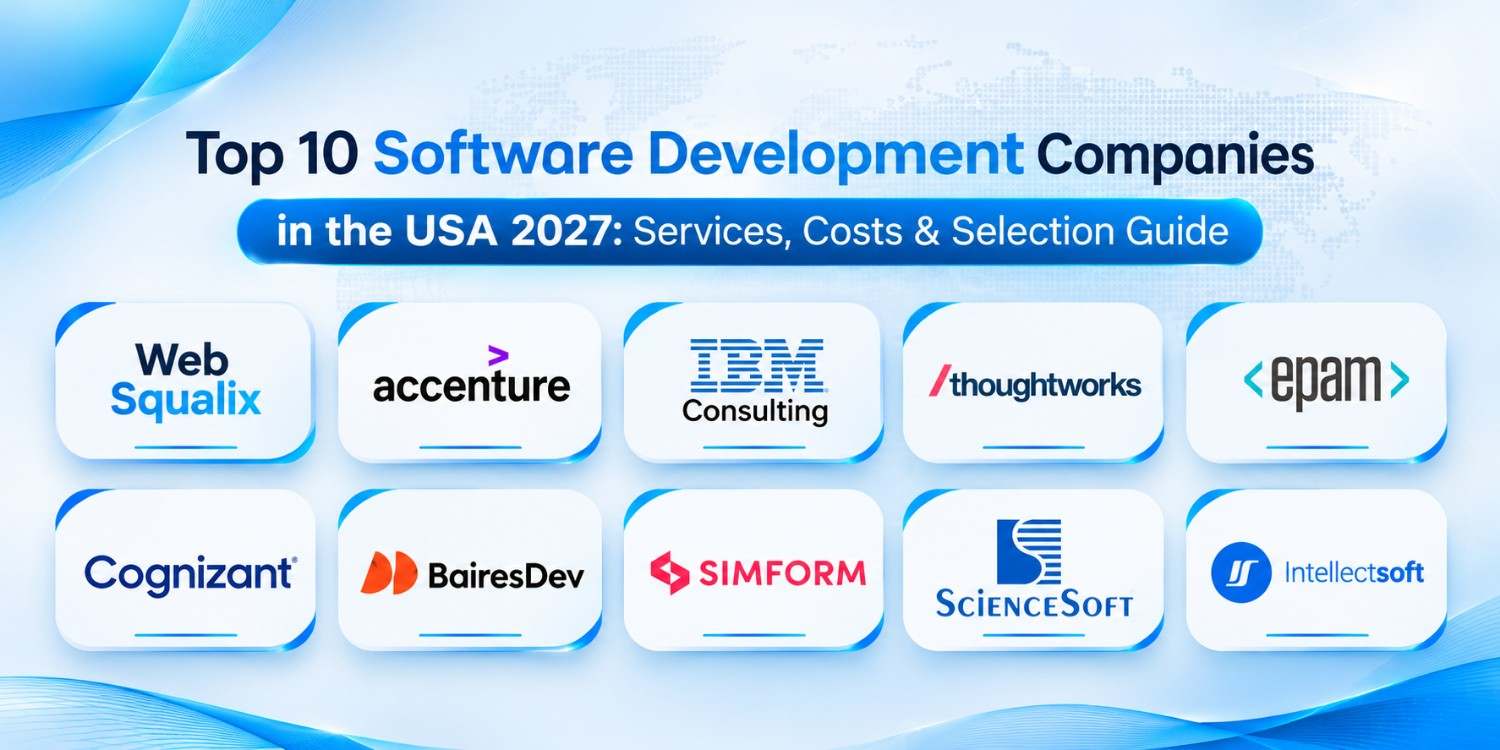
1. Introduction: Choosing a Software Development Partner in the USA
Every software project carries three kinds of risk, and the right vendor is the one that helps you manage the risks that matter most to you. Delivery risk is the chance that the product arrives late, incomplete or unstable. Cost risk is the chance that the final bill drifts far from the first estimate. Dependency risk is the chance that, once the product is live, you cannot maintain, change or move it without the original vendor. Large consultancies tend to reduce delivery risk through process and bench depth, but they can raise cost and dependency risk through complex contracts. Smaller teams can keep pricing and communication simple, though they have less depth to absorb surprises. Neither type is automatically safer. The useful question is which risk you can least afford.
Keep that frame in mind as you read. A clinic group digitising appointment booking worries most about data protection and dependable day-to-day operation. A retailer moving its online store to a new platform worries about cost drift and launch dates. A startup testing a first idea worries about speed and about not overspending before it learns what users actually want. These are illustrative situations, not case studies, and each would weigh the companies below differently. That is why this guide pairs company profiles with sections on services, pricing, selection and contract terms, so you can build a shortlist around your own priorities instead of around a ranking.
The guide is written for founders, product owners, technology leaders and procurement teams who need to move from a loose idea to a short list of credible vendors. Whether you end up with a global consultancy, a mid-sized engineering firm or a newer team such as ours, the evaluation steps in the later sections apply in the same way.
2. Key Takeaways
- There is no single best software development company. The right partner depends on your scope, budget, industry, timeline and the amount of involvement you want
- Large global firms suit large, long-running programmes. Smaller teams often suit focused products, first versions and internal tools
- Compare proposals by the total cost of ownership over several years, not by the hourly rate alone
- Pay for a short discovery phase before accepting any fixed-price quotation. Estimates built without discovery hide their assumptions
- Put code ownership, hosting accounts and handover duties in the contract in clear language
- Meet the people who will actually do the work, and speak with a client whose project resembles yours
- A newer company deserves a smaller first engagement, such as a paid pilot, before a large commitment. That applies to us as much as to any other company on this list
3. Why Many Top Software Company Lists Mislead Buyers
A ranking looks objective, but the method behind it often is not. Some lists sell their top positions. Some reward the companies with the most online reviews, which says more about marketing effort than delivery quality. Others copy each other, so the same handful of names appears everywhere regardless of whether they suit the reader.
Even honest rankings suffer from a deeper problem. A single order cannot capture fit. A global consultancy that is ideal for modernising a bank's core systems may be a poor choice for a startup building its first mobile app, and the reverse is equally true. For that reason this guide does not claim to tell you who is best. It tells you who the companies are, what they are generally known for and what to ask before you trust any of them.
4. How the Companies in This Guide Were Selected
Aside from Web Squalix, the nine companies were chosen using four practical filters: a headquarters in the United States, a long operating history or clearly documented lineage, a substantial software or digital engineering practice, and public information that a reader can verify independently. We also aimed for variety, mixing publicly traded and privately owned firms, very large organisations and mid-sized specialists, and engineering-led companies alongside broader consulting groups.
There are limits worth stating openly. We did not survey clients, audit delivery quality or compare prices, so nothing here is an assessment of how well any company performs on a given project. Many strong smaller firms are not listed because a ten-company article cannot cover a whole market. Use the list as a starting point for your own due diligence, not as a verdict.
5. Understanding Engagement Models Before You Compare Names
Companies that all call themselves software development firms often sell very different things. Knowing the model you need makes the comparison far easier.
- Full-cycle delivery: one provider handles discovery, design, development, testing, deployment and support. This suits teams without strong in-house technical leadership who want one accountable party
- Product engineering: a team builds and evolves a product over time, often alongside your own staff. This suits product-led businesses with a long roadmap
- Team extension: vetted engineers join your team and work under your direction. This needs experienced internal leadership to manage priorities and quality
- Large-scale transformation: a global integrator runs several workstreams across years, usually with formal governance. This suits big organisations with complex systems and heavy compliance duties
Most disappointing projects involve a model mismatch, such as a team extension arrangement with no internal technical lead, or a heavyweight transformation contract for what was really a six-month product build.
6. Web Squalix
Web Squalix is a technology company that launched its website in June 2026. We list ourselves first because this guide is published on our own website, and we would rather say that directly than let the position suggest a ranking. We are a new name. We do not claim a list of past clients, awards, third-party review scores or a team size that we cannot document, and we invite you to judge us against the same checklist used for every other company here.
Our services cover custom web application development, iOS and Android mobile applications, backend and API development, UI and UX design, third-party integrations, AI-supported features and wider custom software work, along with blockchain-related solutions for projects that genuinely need them. For each project, we begin with the business problem, the people who will use the software and the constraints around budget and timing, and only then recommend a technology approach.
What you can expect from us is a written scope before development starts, a clear list of assumptions, plain-language communication and direct access to the people doing the work. We believe this suits startups validating a first product, small and mid-sized businesses replacing manual processes with custom tools, and teams that want to talk to the engineers instead of a chain of account managers. Very large, multi-year programmes with extensive governance requirements are usually better served by the established firms below, and we would say so during an initial conversation.
We are available to work with teams in the United States and will plan meeting windows around your time zone. To discuss a project, use the contact page on this website, email sales@squalix.com or message us on WhatsApp at +91 9646395900. Share your goals, timeline and budget range, and we will respond with questions and an honest view of scope.
7. Cognizant
Cognizant is headquartered in Teaneck, New Jersey, and trades on the Nasdaq under the symbol CTSH. It began in 1994 in Chennai, India, as an in-house technology unit of Dun & Bradstreet and started serving outside clients in 1996. Over the following decades it grew into a broad IT services and consulting organisation with a large presence in the United States, Europe and Asia.
Companies usually look at Cognizant when they need scale: large application portfolios, long-running managed services, data and cloud programmes, or a delivery partner able to staff across several countries. For a small product team with a narrow scope, a provider of this size may feel heavy, so ask early who would actually be on your account and how engagement minimums are set.
8. EPAM Systems
EPAM Systems is headquartered in Newtown, Pennsylvania, was founded in 1993, and has been listed on the New York Stock Exchange under the symbol EPAM since 2012. Its public descriptions centre on software engineering, digital platform engineering and product design, which gives it a more engineering-led reputation than some of the broader consulting groups on this list.
Buyers tend to consider EPAM for substantial product engineering work, platform builds and modernisation efforts where deep technical capacity matters. Because the company serves large enterprises, smaller clients should ask how a project of their size would be staffed and prioritised, and whether the delivery model offers the flexibility an early-stage budget requires.
9. Grid Dynamics
Grid Dynamics is headquartered in San Ramon, California, was founded in 2006 and is listed on the Nasdaq under the symbol GDYN. It describes itself as a digital engineering and AI transformation partner, and its public materials emphasise work for large retail, technology, financial services and consumer goods organisations.
As a mid-sized public company, Grid Dynamics can sit between the very large global providers and boutique studios. It may be worth a closer look if you need engineering depth in areas such as data platforms, cloud-native systems or AI-enabled applications, and you want a partner smaller than the biggest names. As with any vendor, request references that match your industry and scale.
10. IBM Consulting
IBM Consulting is the consulting and services arm of IBM, a company headquartered in Armonk, New York, whose own history stretches back to 1911. IBM is publicly traded on the New York Stock Exchange, and its consulting practice positions itself around enterprise transformation, hybrid cloud and artificial intelligence.
Organisations that already run IBM technology, or that operate in heavily regulated sectors where an established vendor relationship matters, often evaluate IBM Consulting. The trade-off is that a company of this scale tends to organise work through formal programmes and structured contracts. If you value speed and informal collaboration, discuss how your team would interact with delivery staff day to day.
11. Perficient
Perficient is headquartered in St. Louis, Missouri, and traces its origins to the late 1990s. For many years it was listed on the Nasdaq; in October 2024 an affiliate of the investment firm EQT completed its acquisition of the company, and it now operates as a privately held business.
Perficient is generally known as a digital consultancy that implements and integrates commercial platforms, including customer experience, commerce and cloud technologies, alongside custom development. It can be a sensible option when your project combines packaged software with bespoke features. Ask how much of a proposed engagement relies on third-party platform configuration versus custom code, since the cost and maintenance profile of the two are quite different.
12. Slalom
Slalom is a privately held business and technology consulting firm headquartered in Seattle, Washington, founded in 1999. It is organised around local market teams in addition to its national practices, which is a distinctive structure among the companies in this guide.
Clients commonly engage Slalom when strategy, change management and technology delivery need to move together, for example when a product launch depends on new processes as much as new software. If you only need a developer team to execute a fixed specification, confirm that the engagement is scoped around engineering output and not broad advisory work.
13. SoftServe
SoftServe is a privately held software engineering and consulting company with its United States headquarters in Austin, Texas. It was founded in 1993 in Lviv, Ukraine, and moved its US headquarters to Austin in 2014. Its public service descriptions include cloud, data, artificial intelligence, experience design and application development.
Because SoftServe combines a US presence with large engineering teams in Europe, it is often considered by organisations that want a blend of onshore coordination and distributed delivery. If you choose a company with this kind of model, define working hours, overlap with your time zone and how decisions are escalated, so that distance does not slow the project down.
14. Thoughtworks
Thoughtworks was founded in Chicago in 1993 and remains headquartered there. After several years as a public company, it was taken private by funds associated with Apax Partners in November 2024. The company is known in the industry for its emphasis on agile delivery, continuous delivery practices and its regularly published Technology Radar.
Thoughtworks tends to attract organisations that want an engineering culture and delivery discipline to influence their own teams, not only a finished product. It is frequently considered for modernisation, platform engineering and complex digital products. Expect a consultative approach, and clarify how the engagement will transfer knowledge to your internal staff so you are not dependent on the vendor after launch.
15. Virtusa
Virtusa is headquartered in Southborough, Massachusetts, and was founded in 1996. It was listed on the Nasdaq until early 2021, when it was acquired by Baring Private Equity Asia and became a private company. Its public descriptions cover digital engineering, IT consulting, systems integration and platform modernisation, with particular attention to banking, insurance, healthcare and media clients.
Virtusa may be worth examining if your project sits in a regulated or data-heavy industry and you want a provider that organises its practice around those sectors. As with every company here, ask for case studies that resemble your own situation and speak with a reference client about communication, change handling and how problems were resolved.
16. The Ten Companies Compared
The table summarises the public record for each company. Web Squalix is first because it is the publisher; the other nine follow alphabetically. The order is not a ranking.
| Company | Public Record | Typical Focus |
|---|---|---|
| Web Squalix | Newly launched, website live since June 2026 | Custom web and mobile apps, backend and API work, UI and UX, AI-supported features |
| Cognizant | Teaneck, New Jersey; founded 1994; Nasdaq: CTSH | IT services, consulting and digital engineering at scale |
| EPAM Systems | Newtown, Pennsylvania; founded 1993; NYSE: EPAM | Software engineering and digital platform engineering |
| Grid Dynamics | San Ramon, California; founded 2006; Nasdaq: GDYN | Digital engineering and AI-focused transformation |
| IBM Consulting | Armonk, New York (IBM, founded 1911); NYSE: IBM | Enterprise consulting, hybrid cloud and AI-related services |
| Perficient | St. Louis, Missouri; founded 1997; private (EQT) | Digital consulting and platform implementation |
| Slalom | Seattle, Washington; founded 1999; private | Business and technology consulting |
| SoftServe | Austin, Texas (US headquarters); founded 1993; private | Software engineering, data and cloud services |
| Thoughtworks | Chicago, Illinois; founded 1993; private (Apax Funds) | Software design, delivery and modernisation |
| Virtusa | Southborough, Massachusetts; founded 1996; private equity owned | Digital engineering and IT consulting |
17. What Services to Expect From a Software Development Company
The label software development company covers a wide range of businesses, so it helps to know which services belong in a serious proposal. Not every provider offers every item, and you should not pay for capabilities you will not use.
- Discovery and requirements: workshops, user research and a written scope that turns an idea into testable requirements
- UI and UX design: user journeys, wireframes, prototypes and accessible interface design
- Custom application development: web applications, mobile apps and the backend services that support them
- Systems integration: connecting your software to payment services, CRMs, ERPs, identity providers and other third-party systems
- Cloud engineering and DevOps: infrastructure setup, automated deployment pipelines, monitoring and environment management
- Data engineering and analytics: pipelines, reporting layers and dashboards that turn raw records into usable information
- AI and machine learning integration: applied features such as search, recommendations or document processing, with proper evaluation
- Quality assurance: functional, performance, security and device testing, ideally planned from the first sprint
- Application modernisation: gradually updating or replacing ageing systems without interrupting the business
- Maintenance and support: bug fixes, security patches, dependency updates and defined response times after launch
Pay particular attention to quality assurance and post-launch support. These are the items most often thinned out when budgets tighten, and they decide how much you will spend in the second year of the product's life.

18. Understanding Software Development Costs in the USA
Published cost figures for software projects vary enormously, and many come without any explanation of what is included or how they were calculated. For that reason this article does not quote an average price or hourly rate. It explains how pricing works so that you can read a quotation critically, and it encourages you to request written estimates from every vendor you shortlist.
Most vendors use one of four commercial models, and each allocates risk differently.
- Fixed price: an agreed amount for a defined scope. It gives budget certainty but works well only when requirements are stable, and changes are usually handled through formal change requests
- Time and materials: you pay for the hours or days actually worked. It suits evolving products, but it needs active management and clear reporting to keep spending visible
- Dedicated team: a group of engineers, designers and testers working on your product for an extended period, billed as a monthly team cost. It suits long-term product development
- Managed services or retainer: a recurring fee for ongoing support, maintenance and enhancements after launch
Beyond the model, several factors move the price in a consistent direction. Understanding them is more useful than comparing a single headline number.
| Cost Driver | How It Affects the Estimate |
|---|---|
| Scope and feature count | More screens, user roles and business rules mean more design, development and testing time |
| Team seniority and mix | Experienced architects and engineers cost more per hour but can reduce rework and risk |
| Delivery location | Onshore, nearshore and offshore delivery carry different rate levels and coordination needs |
| Integrations | Each external system adds analysis, build and test effort, plus dependency on the provider's own change schedule |
| Security and compliance | Regulated industries need extra design, documentation, testing and audit support |
| Platform choices | Native apps for several platforms usually cost more than a shared cross-platform codebase |
| Data migration | Moving records from an older system is often underestimated and needs its own plan and testing |
| Post-launch needs | Hosting, monitoring, support hours and a roadmap of improvements continue after release |
There are also costs that never appear in the first quotation. Third-party licences, cloud hosting, app store fees, payment processing fees, security reviews, accessibility audits and internal staff time all belong in your total budget. Software also needs money every year after launch, so ask each vendor to describe what ongoing maintenance typically involves and how it is priced.
Be cautious when a quotation arrives within a day or two of a single short call. Estimates built without discovery tend to carry hidden assumptions, and those assumptions usually surface later as change requests. A paid discovery phase, even a short one, often produces a more reliable estimate and gives you a document you can take to other vendors for comparison. The cheapest quotation is rarely the cheapest outcome, because an early architecture mistake can cost far more than a higher hourly rate.
19. Custom Software or Off-the-Shelf Software?
Before choosing a vendor, decide whether you need custom software at all. Ready-made products are often the right answer for common needs, while custom development earns its cost when the software is part of how your business competes.
| Question | Custom Software | Off-the-Shelf Software |
|---|---|---|
| How well does it match your workflow? | Designed around your process | You adapt your process to the product |
| What does it cost at the start? | Usually higher | Usually lower |
| How do costs behave over time? | Maintenance and improvement costs continue, but no per-user licence growth | Licence fees often grow with the number of users |
| Can it become a competitive advantage? | Yes, if it supports something unique | Rarely, since competitors can buy the same tool |
| How flexible is integration? | Planned around your own systems | Limited to what the vendor supports |
| How quickly can you start? | Slower, because it must be built | Faster, because it already exists |
A sensible rule is to buy standard tools for commodity needs, such as email, basic accounting or document storage, and to build custom software only for the capabilities that make your service different. Many businesses combine both, using ready-made products for the foundation and custom applications for the parts that matter most.
20. What a Healthy Development Process Looks Like
Whatever company you pick, a dependable delivery process tends to move through recognisable stages. Ask any vendor to describe theirs and listen for specifics instead of slogans.
- Discovery: goals, users, constraints and how success will be measured
- Design and architecture: wireframes, system design and technology decisions, documented so that you understand the reasoning
- Development: working increments delivered in short cycles, with regular demonstrations you can react to
- Testing: automated and manual checks, including security and performance review, throughout the work and not only at the end
- Deployment: automated release pipelines, environment management and monitoring from the first launch
- Support and iteration: bug fixing, maintenance and a roadmap informed by real usage
The working method matters too. Agile and Scrum methods deliver in short iterations and suit products whose requirements will change as you learn. Kanban focuses on continuous flow and suits support work and ongoing improvements. A sequential, waterfall-style approach can suit tightly defined, compliance-heavy projects where changes must pass through formal approval. Many experienced teams blend these, delivering in iterations while keeping documentation and governance that regulated clients require. A vendor who can explain why a particular method fits your project is usually a better partner than one who insists on a single approach for everyone.
21. How to Select the Right Software Development Partner
Selecting a partner is easier when you follow a sequence. The steps below work for a first project as well as for replacing an existing vendor.
- Define the problem before the solution. Write down who the users are, what outcome you need and how you will know the project worked
- Set a budget range and a decision date. Vendors respond better, and more honestly, when they know the boundaries
- Shortlist three to five companies. Include at least one whose size matches your own, not only the largest names
- Request written responses to the same brief. Identical questions make comparison fair and expose differences in thinking
- Review relevant work, not only logos. Ask for case studies in your industry and for a reference you can speak with directly. If a company is too new to have references, ask for a paid pilot instead
- Meet the actual team. Confirm who will lead the project, who will write the code and how much of their time you will receive
- Examine the process. Ask how requirements are managed, how progress is reported and how disagreements about scope are resolved
- Check security and legal terms. Review data handling, intellectual property ownership, confidentiality and exit provisions
- Start small if possible. A short paid pilot or discovery phase reveals how a vendor communicates before you commit the full budget
In your first meeting, ask questions that surface practical information quickly. Who will be on my team, and will they work on my project full time? Which parts will be done by your own employees and which by subcontractors? Who owns the source code, designs and cloud accounts at the end? How do you handle a change in requirements halfway through, and how is it priced? What does your testing process look like? What happens after launch, and what does support cost? Finally, ask the vendor to describe a project that went wrong and what they changed afterwards. Every experienced team has faced a difficult project, and the way they describe it tells you more about their maturity than a polished case study.
Also watch for warning signs. A fixed quotation delivered with no discovery and no written assumptions, reluctance to let you speak with a past client or the engineers on your project, unusually low pricing that is not explained by a different scope or team mix, vague contract language about intellectual property, and promises that every feature can be delivered quickly without trade-offs all deserve a pause. None of these proves a vendor is unreliable on its own, but several together suggest asking harder questions before signing.
22. Onshore, Nearshore or Offshore: Choosing Where the Work Happens
Where your development team sits affects communication, cost and legal handling more than most buyers expect. Each model has a place.
- Onshore: the team works in your own country and time zone. It simplifies collaboration and legal handling, and suits sensitive or heavily regulated work, but it is usually the most expensive option
- Nearshore: the team works in a nearby country with significant working-hour overlap. It balances cost and collaboration and suits products that need frequent real-time discussion
- Offshore: the team works in a distant time zone. It can offer cost advantages and round-the-clock progress, but it needs clear documentation, disciplined communication and strong product ownership on your side
- Hybrid: leadership, architecture and product decisions sit close to you while execution is distributed. Many successful programmes use this blend
Whatever model you choose, agree in writing on working-hour overlap, response times, how decisions are escalated and which meetings are mandatory. Distance rarely sinks a project by itself; unclear communication does.
23. Software Development Trends to Consider in 2027
Several developments are shaping how projects are planned and how vendors are evaluated. Treat them as questions to ask, not as boxes to tick.
- AI-assisted engineering: many teams use coding assistants and automated testing tools. Ask how generated code is reviewed, tested and checked for licence and security issues
- AI features inside products: search, recommendations, document handling and conversational interfaces are common requests. Insist on a plan for evaluating accuracy, handling errors and protecting user data
- Security by design: secure development practices, dependency tracking and audit-ready pipelines are increasingly expected from the start, not added before launch
- API-first and composable architecture: systems designed around well-documented interfaces are easier to integrate and change over time
- Platform engineering: internal tooling and shared infrastructure that help teams release faster and more consistently
- Outcome-focused contracts: more buyers want payment linked to delivered results and agreed milestones instead of hours alone
- Cloud cost management: with usage-based billing, monitoring and controlling cloud spending has become part of the engineering conversation
24. Industry Considerations That Change the Shortlist
Your industry can change which vendors make sense. Healthcare projects need careful handling of patient information. In the United States, HIPAA applies to covered entities and their business associates, and interoperability standards such as HL7 and FHIR often come up when software must exchange data with clinical systems. Financial applications raise questions about identity verification, anti-money-laundering controls, audit trails and, where card data is involved, the PCI DSS standard. Logistics software depends on reliable integrations with carriers, warehouse systems and tracking devices. Software-as-a-service products need multi-tenant architecture, subscription billing and good observability, and customer relationship tools depend heavily on integration and data migration skills. Ask each vendor for examples that match your sector, and ask what regulatory advice they expect you to obtain separately.
25. Conclusion: Choose for Fit, Not for Size
The companies in this guide differ in size, ownership, working style and typical client. None is the right answer for every project, and none is the wrong answer for every project. The better question is which partner matches your scope, budget, timeline and the level of involvement you want.
Start with a clear brief, ask every vendor the same questions, compare proposals line by line and insist on meeting the people who will do the work. Verify the facts in this article and in any vendor presentation against primary sources, and begin with a small paid phase where you can. We are a newer company and are happy to be evaluated this way. If you would like to talk through a project, get in touch through this website and share your requirements.

Manpreet drives the company’s vision, strategy, and growth, building strong teams and partnerships while helping clients turn ambitious ideas into innovative, scalable digital solutions.