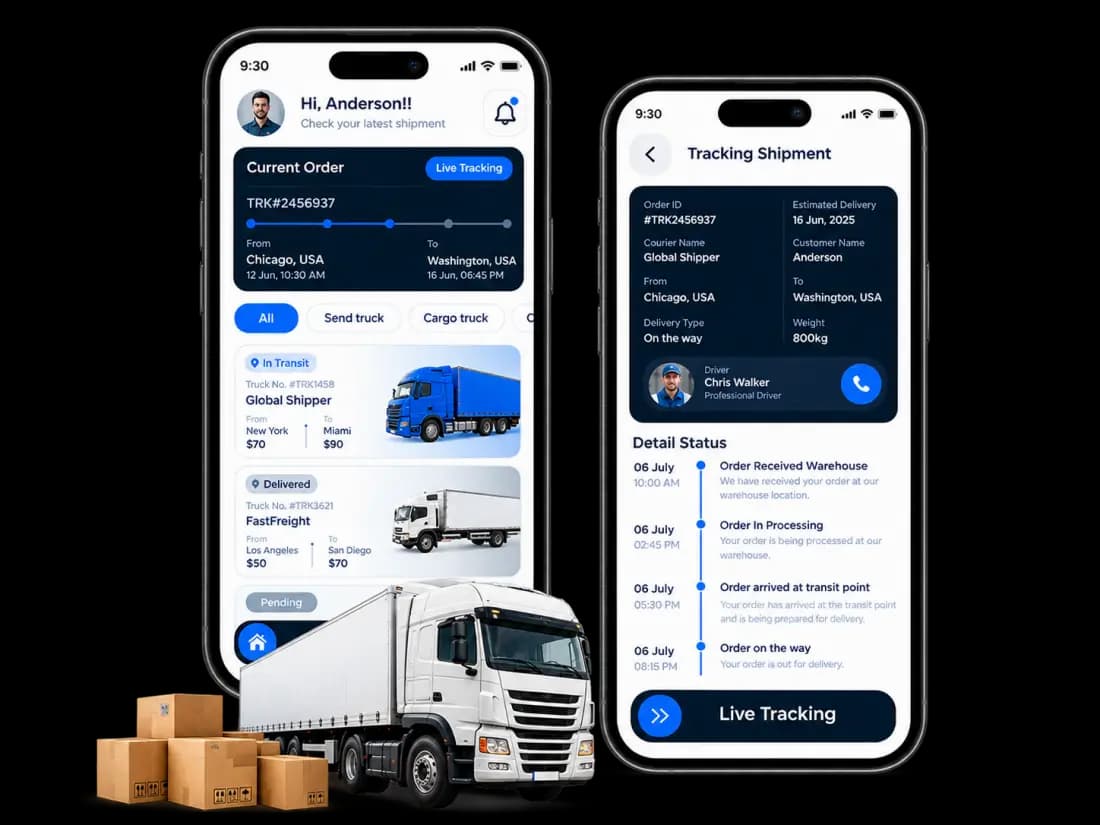
Logistics App Development that moves freight data and decisions together
From fleet tracking and route planning to warehouse automation and last mile delivery we act as a logistics app development company building platforms engineered for scale speed and tight operating margins across road rail and multimodal networks.
Logistics software development that turns supply chains into a clearer advantage
We provide logistics app development for 3PLs fleet operators ecommerce brands and freight carriers building platforms that ingest high volumes of events each day and turn them into live visibility smarter routing and lower delivery costs.
From IoT driven fleet telematics to intelligent demand forecasting our logistics software development solutions are built for the pace and complexity of modern supply chains rather than the slower rhythm of the legacy systems many operators still run.
End to end logistics app development for every link in the chain
Whether you move a modest fleet or thousands of vehicles our logistics app development company builds the digital backbone that keeps operations running without avoidable downtime.
Fleet Management Software Development
Live GPS tracking driver scoring fuel analytics and predictive maintenance built into one fleet management dashboard dispatchers will actually use on busy shifts.
Route Optimization Software
Intelligent route optimization software that cuts miles fuel spend and delivery times with live traffic awareness built directly into the planning engine.
Warehouse Management Systems
Custom WMS with barcode and RFID scanning dynamic slotting pick pack ship workflows and inventory accuracy that regularly exceeds high operational targets.
Last Mile Delivery App Development
Driver dispatcher and customer facing last mile delivery applications with live ETA tracking proof of delivery capture and a checkout experience that supports tips where appropriate.
Supply Chain Analytics
Live KPIs demand forecasting and what if simulations running on a unified data layer that finally gives operations leaders one source of truth.
Freight and Customs Platforms
Multimodal freight booking electronic documentation customs paperwork automation and partner portals built for global trade complexity.
Built with drivers, dispatchers and warehouse operators — not just whiteboards.
From whiteboard to wheels on road in weeks not quarters
Our logistics app development process is tuned for the industry integration heavy data heavy and operationally critical from the first sprint.
Workflow Mapping
We sit with dispatchers drivers and warehouse leads to map every real world flow before a single screen is designed.
Data and Integration Audit
We inventory the ERPs TMS platforms IoT devices carriers and interfaces that the new logistics software must speak to on day one.
Architecture and Event Modeling
We design an event driven geo aware backend built to handle large volumes of location pings and status updates each hour.
Build and Field Test
Two week sprints paired with continuous testing on actual trucks handheld scanners and live warehouse floors not only staging environments.
Rollout and Training
A region by region rollout plan plus hands on driver and dispatcher training designed to drive real day one adoption.
Optimize and Scale
Continuous tuning of models routes and operational KPIs turning raw fleet and warehouse data into measurably stronger margins.
Battle tested technology for high volume logistics workloads
Geolocation live processing and third party connections are first class citizens in every logistics app development project we deliver.
- React
- Next.js
- React Native
- Mapbox
- Deck.gl
- Node.js
- Go
- Kafka
- Redis
- PostGIS
- OR-Tools
- TensorFlow
- PyTorch
- OpenAI
- Snowflake
- MQTT
- AWS IoT
- Telematics SDKs
- Zebra
- Honeywell
- AWS
- GCP
- Kubernetes
- Terraform
- Datadog
Less guesswork more miles margin and momentum
Clients who choose our logistics app development company consistently see meaningful gains in efficiency on time delivery and customer satisfaction within the first two quarters.
Smart route optimization software and load matching keep trucks earning revenue instead of idling empty.
Live visibility across the fleet reduces wait time and rework at every handoff point.
Barcode and RFID driven warehouse workflows and slotting logic that warehouse operators actually adopt and trust.
Photo proof of delivery geo stamps and full audit logs put an end to costly he said she said disputes.
Road rail air and ocean freight orchestrated through a single logistics control tower interface.
Lightweight offline first delivery applications built the way drivers actually want to work every shift.
Ready to digitize your supply chain
Talk to a senior logistics app development engineer about your fleet warehouse or last mile delivery challenge and walk away with a clear roadmap within a short turnaround.
Further reading from our engineering team.
Deep-dives written by the engineers who ship these systems.
- Logistics
Top Technologies Reshaping Logistics Execution
Smart logistics software is replacing spreadsheets and guesswork. Here's a practical look at the IoT, AI, robotics, and cloud platforms actually driving supply chain visibility and logistics automation in 2026.
- Logistics
The Future of Freight: How On-Demand Logistics Software Removes Supply Chain Friction
Freight still runs on phone calls and guesswork more than most people would guess. Here's a practical look at how on-demand logistics software is quietly closing that gap.
- Blockchain & Supply Chain
Automating B2B Supply Chains: Fixing Invoice Disputes with Tech
Discover how smart contracts, automated invoicing, blockchain, and digital reconciliation can reduce B2B supply chain invoice disputes and improve payment workflows.
Frequently Asked Questions
Quick answers to help you make informed business decisions
Do you build logistics software for small fleets or only enterprise operators?
Both. Our logistics app development company has shipped systems for regional carriers and global 3PLs and we scope the architecture differently depending on current volume and growth plans.
How accurate is your route optimization software in practice?
We use established optimisation libraries alongside heuristics tuned to specific delivery constraints and clients typically see route optimization software reduce total miles driven by a meaningful margin within the first month of use.
What is the difference between a fleet management platform and a TMS?
A fleet management platform focuses on the vehicles themselves tracking maintenance driver behaviour and fuel while a transportation management system focuses on planning and executing shipments across carriers. Our logistics software development team frequently builds both together so fleet data feeds directly into shipment planning decisions.
Can you build a last mile delivery app that supports tipping and live tracking?
Yes last mile delivery app development is one of our core specialties and we routinely build customer facing applications with live driver tracking tip friendly checkout flows delivery window scheduling and automated notification messaging.
How do you handle IoT and telematics data from trucks and warehouse equipment?
Our logistics app development company builds on MQTT and cloud IoT pipelines that ingest telematics and scanner data at scale processing large event volumes through streaming so dashboards and alerts stay current in real time rather than updating in batches.
What kind of analytics and reporting come with a logistics platform build?
Every logistics software development engagement includes a supply chain analytics layer with live KPI dashboards demand forecasting models and what if simulation tools giving operations leaders one unified view instead of pulling reports from five disconnected systems.
What should operators examine before starting fleet management software development?
Examine vehicle count telematics hardware already installed hours of service rules and which maintenance events cause the most downtime. Fleet management software development succeeds when those operational constraints shape the data model from the first architecture decisions.
Can you integrate with our existing TMS or ERP system?
Yes. We regularly connect logistics software with SAP Oracle Manhattan Blue Yonder NetSuite Shopify and most major carrier interfaces so you are not forced to rip and replace systems that already work for the team.
Do your fleet and warehouse apps work offline?
Yes. Every driver and warehouse application we build through our logistics app development process is offline first with smart background sync that catches up automatically once connectivity is restored in low signal areas.
How long does a typical logistics app development project take?
A focused fleet management or route optimization software build usually takes several weeks from workflow mapping through field testing. A full logistics platform spanning fleet warehouse and last mile delivery typically runs longer depending on integration complexity and rollout scope.
Do you support cold chain or temperature sensitive logistics?
Yes. We build warehouse management systems and fleet monitoring tools with temperature zone tracking lot level traceability and compliance reporting for cold chain and perishable goods distributors where a missed reading can mean a full batch loss.
Can existing legacy logistics software be modernized instead of rebuilt from scratch?
Often yes. We start with a data and integration audit to identify which parts of the legacy TMS or WMS still work and which are holding you back then modernise incrementally wrapping stable systems with modern interfaces while replacing the components causing the most operational pain.
Do you provide support after the logistics platform goes live?
Yes every project includes a post launch support period covering bug fixes performance monitoring and driver or dispatcher feedback triage. Many clients move into a retained engagement afterward so we can keep tuning route optimization software and adding features as fleet size and delivery volume grow.
How does warehouse management system design differ for multi site operators?
Multi site warehouse management system design needs shared item masters site level inventory rules and transfer workflows between locations. Single site systems can hide those requirements until the second warehouse opens and data models no longer fit.