Cloud architectures built for real operations.
We design and run production cloud environments on AWS, Google Cloud, and Azure using infrastructure as code, clear cost visibility, and reliability practices so teams can scale capacity without losing control of spend or stability.
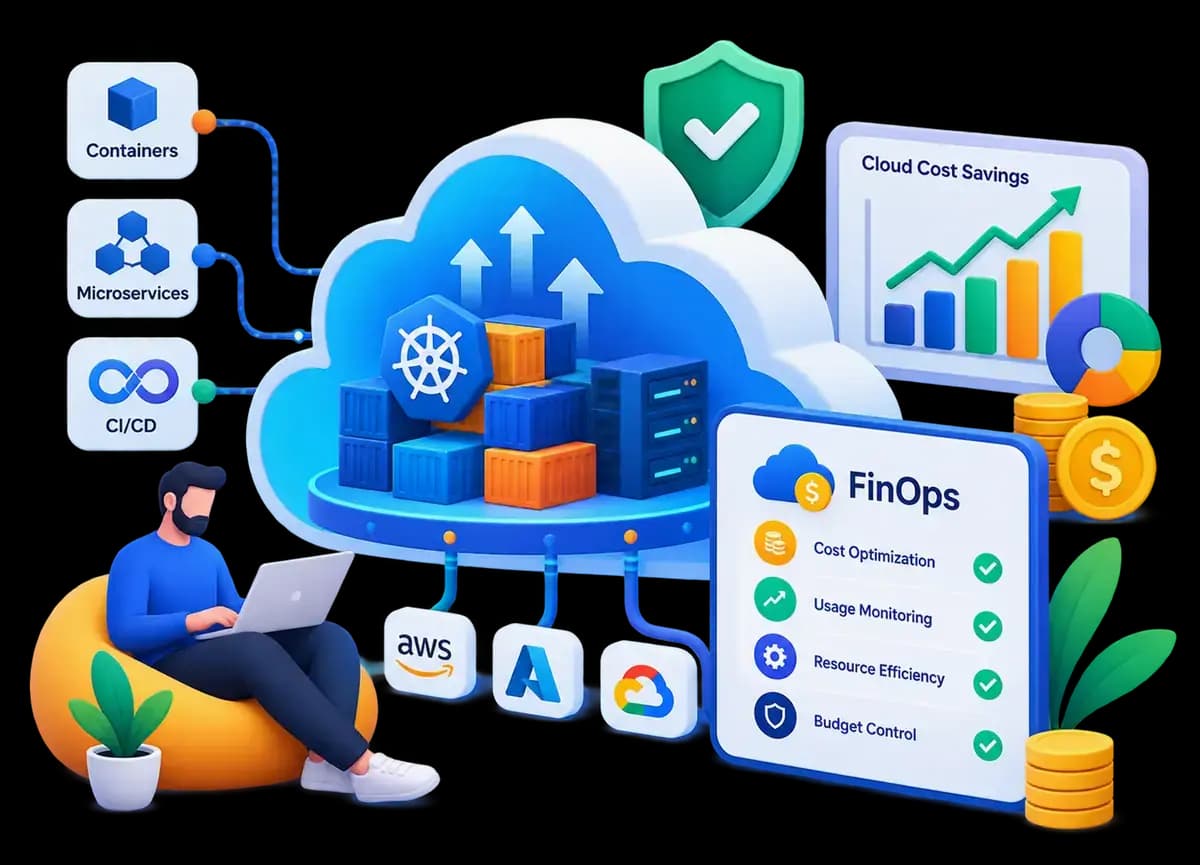
Cloud work succeeds when it is treated as engineering.
Many organisations move workloads to the cloud and later discover that cost, reliability, and operational ownership did not improve automatically. Effective cloud solutions combine architecture choices, migration sequencing, and day two operating models rather than treating the cloud as a simple relocation of servers.
We help teams plan multi cloud or single cloud footprints, modernise applications where it creates clear value, introduce infrastructure as code, and apply FinOps practices so spending stays visible and attributable. The goal is infrastructure that supports product delivery instead of becoming a recurring source of surprise bills and manual firefighting.
What we deliver for cloud platforms
Multi cloud architecture
Workload placement decided by fit across AWS, Google Cloud, and Azure rather than vendor preference alone.
Kubernetes platforms
Managed clusters on EKS, GKE, or AKS with sensible autoscaling, packing, and operational guardrails.
Infrastructure as code
Terraform, Pulumi, or CDK so every environment can be reviewed, reproduced, and recovered from version control.
FinOps and cost control
Tagging, attribution, rightsizing, and regular reviews that connect spend to teams and products.
Reliability practices
Service level objectives, error budgets, and on call models that keep reliability decisions explicit.
Migration and modernisation
Lift and improve paths for on premises systems and staged decomposition of monolithic applications.
Outcomes teams usually care about
Clearer monthly spend
Visibility into where money goes and which workloads drive the largest share of cost.
More predictable reliability
Defined objectives and error budgets replace vague uptime expectations.
Faster safe releases
Git based delivery pipelines that reduce manual steps between merge and production.
Audit friendly operations
Changes and configurations captured in code and logs that support compliance evidence.
Our Software Development Process
How we take an idea from the first workshop to a monitored production release.
Agile Approach
We follow an Agile methodology to plan, design, and develop your project efficiently, adapting to changing requirements and improving performance.
Management Driven
Top-line managers oversee your project scope, ensuring priorities are set correctly and progress is continuously monitored for optimal results.
Open Communication
We maintain transparency through active communication via Slack, Trello, Email, and Skype, keeping you informed at every stage.
Continuous Delivery
We deploy code safely and rapidly to production environments, delivering updates continuously to ensure your product evolves in real time.
Resource Extension
We adapt to changing operational needs by extending resources and manpower as required, keeping your project on track without delays.
Maintenance & Support
After delivery, we provide ongoing maintenance and support, ensuring your software remains secure, optimized, and fully functional.
Recent results.

Technologies We Work With
Web Squalix works with modern and high-performance technologies that have no integration issues and make your future growth faster.
Reliable and scalable databases for modern applications.
 MySQL
 PostgreSQL
 MongoDB
 Firebase
 Redis
 MariaDB
 SQLite
Modern and interactive user interfaces for seamless experiences.
 React.js
 Next.js
 Vue.js
 Angular
 TypeScript
 Tailwind CSS
 Bootstrap
 Three.js
Powerful and flexible backend solutions for high performance.
 Node.js
 Go
 NestJS
 PHP
 GraphQL
 Python
 Django
 FastAPI
Frequently Asked Questions
Quick answers to help you make informed business decisions
What do cloud solutions typically cover for a growing business?
Cloud solutions usually include architecture design, account and network setup, migration planning, application modernisation choices, infrastructure as code, observability, and ongoing cost and reliability practices. The exact mix depends on whether the priority is migration, new product platforms, or stabilising an existing cloud footprint.
What is the practical difference between cloud native and traditional application approaches?
Traditional systems are often built as large units that assume fixed infrastructure. Cloud native approaches favour smaller deployable services, containers or serverless units, automated delivery pipelines, and designs that expect infrastructure to scale and fail independently. The shift is useful only when it reduces operational friction or improves delivery speed for the specific product.
How should a company start a cloud migration without disrupting live services?
Successful migrations begin with a clear inventory, dependency mapping, and a sequenced plan that separates low risk moves from systems that need redesign. Parallel environments, controlled cutover windows, and rollback paths reduce risk. Treating migration as a series of reversible steps is safer than a single large switch.
What does infrastructure as code change in practice?
Infrastructure as code means networks, clusters, policies, and supporting services are defined in version controlled files. Changes go through review, environments stay consistent, and recovery becomes a matter of reapplying known configuration instead of reconstructing settings from memory or tickets.
What should teams expect from a FinOps focused engagement?
A typical engagement improves cost visibility, establishes ownership for major spending areas, identifies quick rightsizing opportunities, and sets a repeating review rhythm. Longer term work often includes architecture changes that reduce waste while preserving required performance and resilience.
What does a realistic cloud modernisation path look like for a monolith?
Many teams start by stabilising the existing system in the cloud, improving delivery automation, and extracting only the parts that create clear scaling or ownership benefits. Full decomposition is rarely the first step. Incremental boundaries and measurable outcomes keep modernisation aligned with business value.
Can you help with multi cloud strategy without forcing unnecessary complexity?
Yes. Multi cloud is useful when there is a concrete reason such as data residency, specific managed services, or risk distribution. We help teams avoid accidental complexity by choosing the smallest set of platforms that meet real constraints and by keeping shared patterns where they reduce effort.
How does FinOps fit into day to day cloud operations?
FinOps connects engineering, finance, and product owners around shared visibility of cloud spend. It covers tagging, allocation, rightsizing, commitment planning, and regular reviews so cost decisions stay linked to actual usage and business priorities rather than appearing only as a monthly invoice surprise.
Which cloud platforms and tools does Web Squalix work with?
We work across Amazon Web Services, Google Cloud Platform, and Microsoft Azure. Common building blocks include managed Kubernetes, Terraform or Pulumi for infrastructure as code, container tooling, CI/CD pipelines, and observability stacks. Tool choices follow workload needs and team skills rather than a single fixed stack.
Can cloud solutions support both startups and larger enterprise environments?
Yes. Early stage teams often need a clean foundation, automated delivery, and cost guardrails. Larger organisations usually need stronger account structure, identity boundaries, compliance evidence, and FinOps processes that work across many teams. The same principles scale when the operating model matches the organisation size.
How do you approach Kubernetes platform decisions?
Managed services such as EKS, GKE, or AKS reduce undifferentiated cluster operations. We focus on node efficiency, autoscaling behaviour, workload isolation, observability, and the surrounding delivery and policy controls. Kubernetes is useful when the operational model and team skills can sustain it.
How is security handled in cloud architecture work?
Security is addressed through account structure, identity and access design, network boundaries, encryption choices, logging, and policy controls that travel with the infrastructure code. The aim is consistent baselines that teams can extend rather than one off hardening after deployment.
How do reliability practices such as SLOs help product teams?
Service level objectives make reliability expectations explicit and give teams a shared way to decide when to invest in stability versus new features. Error budgets turn those objectives into operational signals instead of leaving uptime as an undefined aspiration.
What happens after the initial cloud platform is in place?
After the foundation is live the focus shifts to operating discipline: cost reviews, reliability signals, delivery pipeline improvement, and capacity planning. Cloud value compounds when the platform is treated as a product that continues to receive attention rather than a one time project.
You might also need.
Web Development
Scalable and SEO-friendly web development solutions using modern technologies like React, Node.js, and Next.js. Build fast, responsive, and high-performing websites that boost online visibility and business growth.
Mobile App Development
High-performance iOS and Android mobile app development using Flutter, React Native, and native technologies. Build user-friendly, scalable apps that enhance engagement and customer retention.
Software Security
Comprehensive software security best practices and secure development solutions to protect your applications from vulnerabilities, threats, and compliance risks.
AI Development
AI-powered automation, machine learning solutions, and intelligent business tools that improve efficiency, reduce manual work, and enhance data-driven decision-making using advanced AI models.
Further reading from our engineering team.
Deep-dives written by the engineers who ship these systems.
- Cloud & DevOps
AWS vs Azure vs Google Cloud: Which Cloud Platform Is Best for Your Business?
Compare AWS, Azure, and Google Cloud for business hosting, including pricing, performance, security, scalability, enterprise infrastructure, and cloud migration strategy.
- Web Development
Why Does My Website Go Down at Midnight? (5 Proven Fixes)
Is your website going down at midnight every night? Learn why scheduled jobs, backups, server overload, database tasks, and hosting issues can cause recurring downtime—and discover five practical fixes.
- Full Stack
Modern Full-Stack Architecture in 2026: What Senior Teams Actually Pick
Cutting through the framework noise — the stack choices we ship to production and the ones we walked back.

Ready to review your cloud setup? Talk to us.
Share your current footprint and priorities. We will outline practical next steps for architecture, cost visibility, and operations.