What Is Blockchain Development,and Why Does It Matter in 2026?
blockchain development is about building systems where transactions get recorded across a network of computers instead of one central database. No single company or server holds all the control. The idea itself has been around for years, but 2026 feels different — the tools are better now, Layer 2 scaling has made transactions actually affordable, and the rules around blockchain are clearer than they used to be. What hasn't changed is the reason people use it in the first place: you don't need to trust a middleman, because the records can't be quietly altered, and anyone can check them for themselves.
Why Are Businesses Investing in Blockchain Development in 2026?
The top driver is trust reduction — replacing manual reconciliation with a shared, verifiable ledger. A close second is auditability, especially in regulated industries where proving data integrity is a constant requirement.
- Faster cross-border payment settlement
- Verifiable audit trails for compliance
- Automated multi-party agreements via smart contracts
- Greater supply chain transparency
The businesses succeeding aren't chasing a brand story — they're targeting narrow, high-friction processes where removing a manual step produces a measurable return.
Which Industries Are Leading Blockchain Adoption?
Financial services leads, driven by tokenized assets and cross-border settlement. Supply chain and logistics is close behind, using blockchain for provenance tracking in food safety, pharma, and luxury goods. Healthcare is adopting more cautiously, mainly for interoperable records and clinical trial data integrity.
- Financial services — tokenized assets, trade finance
- Supply chain — provenance and counterfeit prevention
- Healthcare — interoperable records, trial data integrity
- Real estate — fractional ownership, title verification
- Government — identity verification, public records
What Are the Main Types of Blockchain Networks?
Public blockchains, like Ethereum, are open to anyone and fully decentralized — strong trust, less privacy. Private blockchains restrict access to one organization, trading decentralization for speed and control. Consortium blockchains are governed by a defined group of organizations, common in supply chain and banking.
| Factor | Public | Private | Consortium |
|---|---|---|---|
| Access | Open to anyone | One organization | Approved group |
| Decentralization | Highest | Lowest | Moderate |
| Speed | Slower | Fastest | Fast |
| Best for | Public trust, tokenized assets | Internal systems | Multi-party networks |
How Are Smart Contracts Transforming Business Operations?
Smart contracts are self-executing code that carries out an agreement automatically once conditions are met, cutting out manual processing. Insurance payouts, trade finance approvals, and royalty distributions increasingly execute in minutes instead of weeks.
- Automated escrow tied to verified delivery
- Instant, proportional royalty payments
- Supply chain payments triggered by goods receipt
The trade-off: smart contracts demand rigorous auditing, since a deployed bug is costly to fix after the fact.

What Are the Benefits of Custom Blockchain Development?
Custom development gives control over performance, governance, privacy, and integration with existing enterprise software — built around your actual data model rather than adapted to fit one. It's the right call for genuinely unique compliance or throughput needs; it's overkill for simpler use cases an existing platform already serves.
How Much Does Blockchain Development Cost in 2026?
Costs vary widely by scope, network type, and how much custom infrastructure is needed — there's no universal figure. The biggest cost drivers are consensus complexity, security audit depth, integration scope, and ongoing maintenance. The most reliable way to control cost is starting with a narrowly scoped pilot before a full rollout.
How Long Does It Take to Develop a Blockchain Application?
Timelines depend on scope. A narrow proof of concept on an existing network can reach testnet in weeks. A full enterprise solution with custom consensus rules and multiple integrations typically takes several months. Security auditing is the most commonly underestimated phase — and shouldn't be rushed to hit a deadline.
What Programming Languages Are Commonly Used for Blockchain Development?
The language typically follows the platform choice.
- Solidity — Ethereum and EVM-compatible chains
- Rust — high-performance chains like Solana
- Go — blockchain infrastructure, Hyperledger Fabric tooling
- JavaScript/TypeScript — wallet and application layers
How Secure Are Blockchain Applications?
The underlying protocol is generally very secure on established networks. Most real-world incidents come from application-layer issues — smart contract bugs, weak key management, or insecure integration points — not the blockchain itself. Independent security audits before deployment are essential, not optional.
How Is Blockchain Different from Traditional Databases?
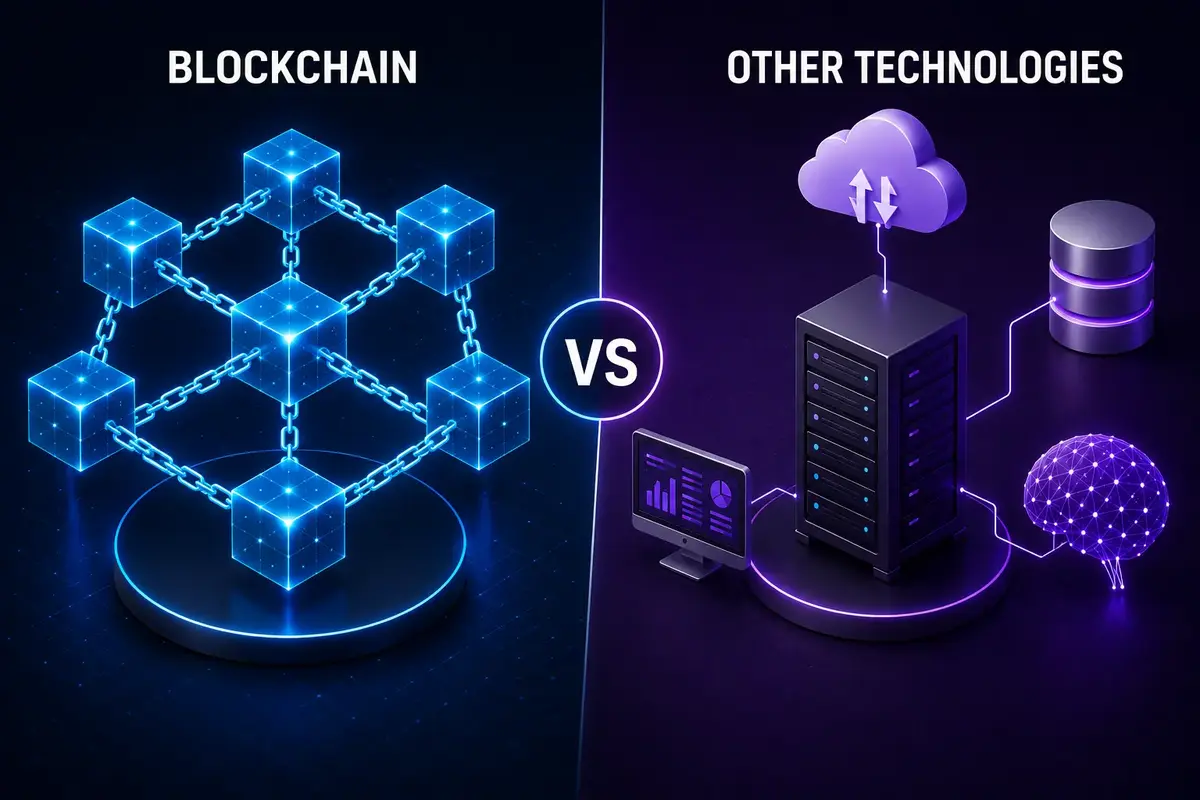
A traditional database has a single owner who controls reads and writes; trust rests on that owner. A blockchain distributes control, making records tamper-evident with no single party able to alter them unilaterally.
| Factor | Traditional Database | Blockchain |
|---|---|---|
| Control | Single owner | Distributed |
| Trust model | Trust the owner | Trust the protocol |
| Write speed | Fast | Slower |
| Best for | Internal, single-owner data | Multi-party shared records |
What Are the Biggest Challenges Businesses Face When Adopting Blockchain?
- Integration complexity with existing enterprise systems
- Regulatory uncertainty in some jurisdictions
- Talent scarcity for experienced blockchain developers
- Unclear ROI when applied to a problem that didn't need it
That last point matters most — many stalled projects fail because the business case never justified the added complexity in the first place.
How Do Businesses Choose the Right Blockchain Platform?
Start from the trust model your use case needs (public, private, or consortium) — that alone eliminates most unsuitable options. From there, weigh transaction throughput, smart contract ecosystem maturity, and existing partner adoption. The strongest choice is rarely the newest platform — it's the one with the deepest track record for your specific workload.
What Is the Difference Between Public, Private, and Consortium Blockchains?
The real difference is governance. Public chains change through broad community consensus — maximum trust, slower adaptation. Private chains put governance in one organization's hands — fast, but less independently verifiable. Consortium chains split governance across a defined group — slower than private, more adaptable than public.
Why Are Layer 2 Blockchain Solutions Important?
Layer 2 solutions handle transactions off the main chain and then settle a compressed summary back onto it, which cuts down both cost and confirmation time without giving up the base layer's security guarantees. That's a big part of why public-chain enterprise solutions have become viable for high-volume use cases like micropayments and IoT transactions — something that just wasn't practical before.
What Role Does Blockchain Play in Supply Chain Management?
For supply chains, blockchain provides a shared, tamper-evident record of a product's journey — which matters most when multiple independent organizations all need to trust the same data without a middleman vouching for it. In food safety, that means tracing a contamination source in minutes instead of days. In pharma and luxury goods, it's used to verify authenticity and keep counterfeits out of the supply chain.
Which Blockchain Platforms Are Most Popular in 2026?
- Ethereum — public smart contracts, largest ecosystem
- Hyperledger Fabric — permissioned, enterprise, and consortium networks
- Solana — high-throughput payments and consumer apps
- Cloud-integrated platforms (Azure, IBM) — deep cloud infrastructure fit
Does Your Business Actually Need a Blockchain?
Blockchain solves one specific problem: establishing trust between multiple parties who don't fully trust each other. If your data only needs internal trust, a traditional database is almost always faster, cheaper, and simpler.
- Do multiple independent parties need to trust the same record?
- Is manual reconciliation genuinely costly or error-prone today?
- Would tamper-evidence create measurable value, not just reassurance?
Should You Build on a Public or Private Blockchain?
If outside parties need to independently verify your data, public blockchain provides that in a way private chains can't. If trust is internal or limited to known partners, private or consortium chains offer better performance and control. Many businesses now land on a hybrid — private data anchored periodically to a public chain for added tamper-evidence.
How Can a Business Successfully Start Its Blockchain Development Journey?
- Identify one high-friction, multi-party process worth solving first
- Define a measurable success metric before writing code
- Choose the trust model and platform that fit the problem
- Build a narrowly scoped pilot
- Commission independent security auditing before production
- Expand only after the pilot shows measurable value
Blockchain Development Fundamentals
The core technical concepts behind every decision above:
Decentralized Architecture
Data storage and validation spread across many independent nodes instead of one server, removing any single point of failure or control.
Consensus Mechanisms
The rules a network uses to agree on valid transactions without a central authority. Proof of Stake now dominates major public networks for its lower energy cost.
Smart Contracts
Self-executing code that enforces an agreement automatically once conditions are verified, removing the need for a manual intermediary.
Cryptography
The hashing and key-pair systems that make records tamper-evident and let users prove ownership without exposing credentials.
Tokenization
Representing a real-world or digital asset as a blockchain unit, enabling fractional ownership and programmable transfer rules.
Interoperability
The ability for different blockchain networks to exchange data or value, increasingly essential as adoption spreads across industries.
Scalability
A network's ability to handle more transactions without a proportional rise in cost or delay — the problem Layer 2 was built to solve.
Security
Spans protocol-level cryptography, smart contract code correctness, and operational key management — weakness in any layer undermines the whole system.
Enterprise Adoption
Has matured from isolated pilots into integrated infrastructure decisions, backed by clearer regulation and more proven production use cases.
"Blockchain isn't a technology upgrade you apply everywhere — it's a trust model you apply exactly where a trust problem actually exists."
Conclusion
Blockchain development in 2026 has settled into a pragmatic phase. Its core value — replacing manual, trust-dependent processes with verifiable shared records — is proven across finance, supply chain, and healthcare. The businesses succeeding with it evaluate whether their problem involves genuine multi-party trust friction, pick the right network for it, and start small.
If your business has a high-friction, multi-party process where trust or automation could unlock real value, the smartest next step is a focused conversation about fit — not a broad blockchain strategy.

John leads the company’s blockchain strategy and development, driving secure and scalable solutions across smart contracts, decentralized applications, and blockchain infrastructure.