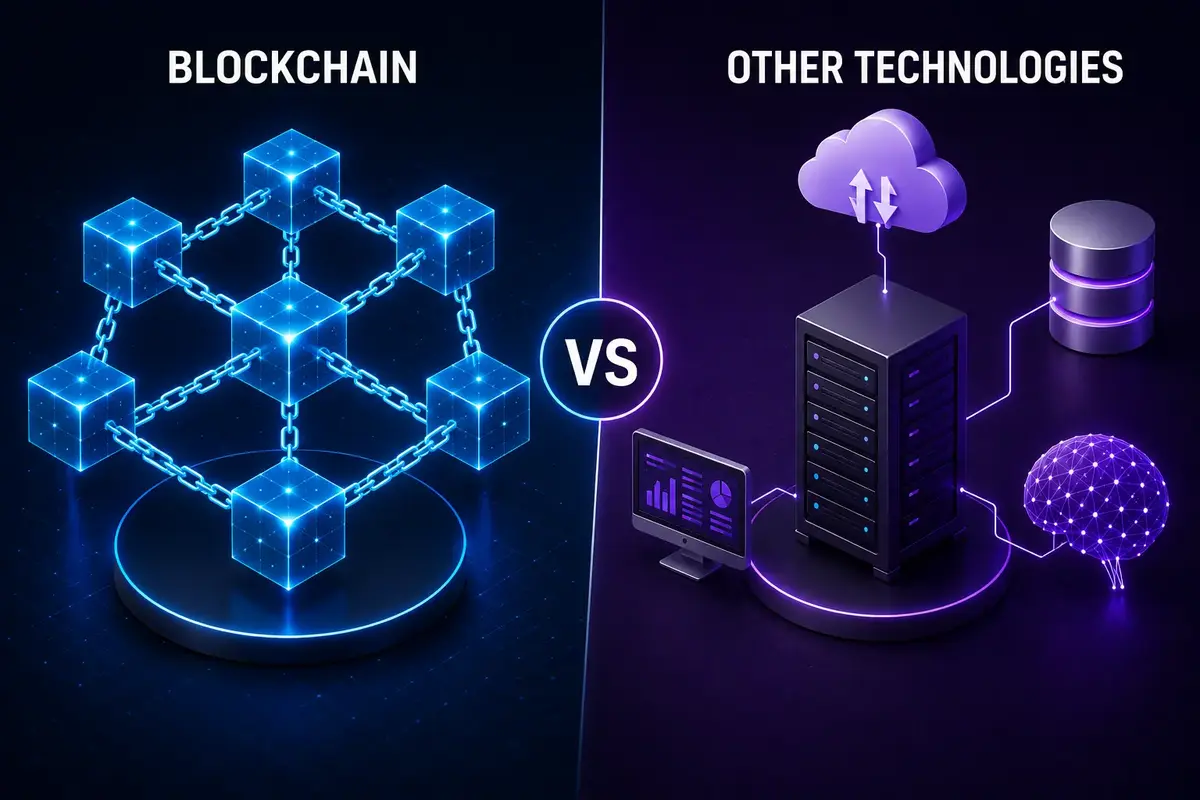
What Is Blockchain Technology?
At its core, blockchain is a way of recording data across a network of participants instead of a single central authority. Each new entry is bundled into a block, linked cryptographically to the one before it, and confirmed through a consensus mechanism that participants agree on collectively.
- Decentralization — no single party controls the entire record
- Distributed ledger — the same data is replicated across participating nodes
- Consensus mechanisms — network participants agree on which entries are valid before they're recorded
- Immutability — once confirmed, records are extremely difficult to alter retroactively
- Transparency — participants can typically verify the ledger's history independently
- Cryptographic security — entries are secured using cryptographic hashing and signatures
None of this makes blockchain a general-purpose replacement for a database or a server. It's a specific answer to a specific problem: how do multiple parties who don't fully trust each other agree on a shared record.
Blockchain vs Traditional Databases
A traditional database is centralized. One organization owns it, controls who can read or write to it, and can update or delete records as needed. That's exactly what most applications want — fast, flexible, and administratively simple.
Blockchain flips that arrangement. Data ownership is distributed across participants rather than held by one party, records generally can't be edited once confirmed, and every write has to go through the network's consensus process rather than a direct update. That makes blockchain slower for everyday read and write operations, but it solves a problem databases can't: proving to multiple untrusting parties that a record hasn't been quietly changed after the fact.
For an internal application with one clear owner, a traditional database is almost always the better fit. For a record multiple independent parties need to trust equally, blockchain has a real advantage.
Blockchain vs Cloud Computing
This comparison trips people up because blockchain and cloud computing aren't actually solving the same problem. Cloud computing is about infrastructure — servers, storage, and compute made available on demand, usually through a centralized provider. Blockchain is about how data is recorded and agreed upon, regardless of where the underlying servers live.
In practice, the two are often used together. Blockchain nodes still need somewhere to run, and cloud infrastructure is a common place to host them. A company might run a blockchain network for supply chain tracking while relying entirely on cloud infrastructure for the servers, storage, and application layer surrounding it.

Blockchain vs Artificial Intelligence
Blockchain and AI get grouped together in a lot of marketing material, but they don't overlap much in what they actually do. Blockchain's job is recording and verifying data. AI's job is analyzing data and making predictions or decisions based on patterns.
- Core purpose — blockchain verifies and records; AI analyzes and predicts
- Data handling — blockchain stores data with integrity guarantees; AI processes data to find patterns
- Decision-making — blockchain doesn't make decisions on its own; AI models are built specifically to
- Automation — AI automates judgment-based tasks; blockchain automates trust and verification through smart contracts
- Security focus — blockchain secures the integrity of records; AI security focuses on model and data protection
Where they do intersect is interesting: a smart contract can trigger based on an AI model's output, or an AI system can use blockchain records as a verified data source. But neither one is a substitute for the other.
Blockchain vs Other Distributed Technologies
Blockchain is one specific implementation of distributed ledger technology, not the only one. It's worth separating a few terms that often get used interchangeably.
- Distributed databases — data is spread across multiple servers for performance and redundancy, but usually still controlled by one organization
- Peer-to-peer networks — participants share resources directly without a central server, but without blockchain's consensus or immutability guarantees
- Distributed ledger technology (DLT) — the broader category blockchain belongs to; not every DLT uses a chain of blocks
- Traditional centralized systems — a single authority controls the infrastructure and the data, the opposite end of the spectrum from blockchain
Blockchain vs Traditional Databases vs Cloud Computing vs AI: A Quick Comparison
| Factor | Blockchain | Traditional Database | Cloud Computing | AI |
|---|---|---|---|---|
| Primary purpose | Verify and record shared data | Store and manage structured data | Provide on-demand infrastructure | Analyze data and generate predictions |
| Architecture | Decentralized, distributed nodes | Centralized, single owner | Centralized provider, distributed access | Model-based, runs on any infrastructure |
| Data control | Shared across participants | Controlled by one organization | Controlled by the provider and customer | Controlled by whoever trains and hosts the model |
| Scalability | Limited by consensus overhead | High, well understood | High, elastic by design | High, dependent on compute available |
| Security approach | Cryptographic consensus, tamper resistance | Access controls, encryption | Provider-managed security layers | Model and data protection, adversarial risk |
| Best use cases | Multi-party trust, auditability | Internal apps, transactional systems | Hosting, storage, scalable compute | Prediction, automation, pattern recognition |
Key Benefits and Limitations of Blockchain
Blockchain's advantages are real, but they come with trade-offs that are worth being honest about upfront.
- Decentralization — removes single points of control and failure
- Transparency — participants can verify the ledger independently
- Traceability — every change is recorded and attributable
- Tamper resistance — confirmed records are difficult to alter after the fact
- Reduced dependency on intermediaries for certain transaction types
- Strong security guarantees for the integrity of the record itself
- Scalability — consensus mechanisms limit transaction throughput compared to centralized systems
- Transaction speed — confirmations can take longer than a direct database write
- Energy considerations for certain consensus mechanisms, though this varies significantly by design
- Regulatory uncertainty in some jurisdictions and industries
- Development complexity compared to conventional application architecture
- Integration challenges when connecting blockchain systems to existing infrastructure
When Should Businesses Choose Blockchain?
Blockchain earns its complexity in situations where multiple independent parties need to trust a shared record without relying on each other, or on a single middleman.
- Supply chain tracking — verifying product origin and custody across multiple companies
- Digital identity — giving individuals verifiable control over their own credentials
- Financial services — settlement and transaction records across institutions
- Asset tokenization — representing ownership of physical or financial assets on a shared ledger
- Cross-border payments — reducing reliance on intermediary banks for settlement
- Healthcare data sharing — coordinating records across providers who don't share a single system
- Smart contracts — automating agreements that execute based on predefined, verifiable conditions
For a lot of other situations — an internal tool, a single-owner application, a system that just needs to scale and doesn't involve multiple untrusting parties — a traditional database or cloud-based architecture will do the job with far less overhead.

Conclusion
Blockchain, databases, cloud computing, and AI aren't competing technologies — they're different tools built for different jobs, and most real systems end up using more than one together. The question worth asking isn't which technology is best, but which problem is actually being solved: storing data, hosting infrastructure, analyzing patterns, or establishing shared trust between parties who don't otherwise trust each other.
For businesses weighing whether blockchain fits a specific use case, or how it might work alongside existing systems, Web Squalix helps evaluate the right architecture before committing to one.

John leads the company’s blockchain strategy and development, driving secure and scalable solutions across smart contracts, decentralized applications, and blockchain infrastructure.