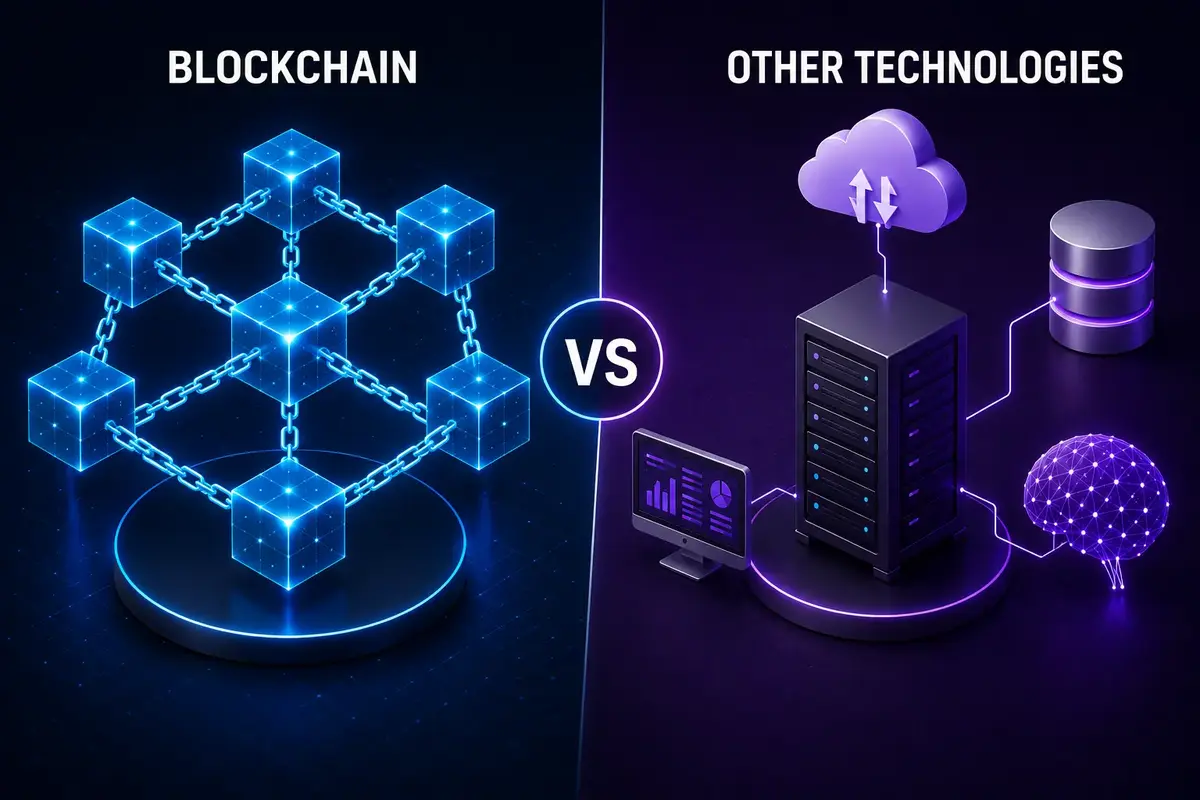
What Is Blockchain Architecture, Really?
Strip away the buzzwords and blockchain architecture is just a way of structuring a network so that no single party controls the record of what happened. Every participant — often called a node — keeps a copy of the ledger. A new transaction only gets added once the network agrees it's valid, and from that point on it's locked in — undoing it would mean rewriting every block that came after. This is the mechanic people are actually referring to when they call blockchain 'tamper-resistant.'
But architecture isn't just the ledger. It covers the whole full stack — how nodes talk to each other, how they agree on what's true, how smart contracts run, how data gets stored, and how the applications sitting on top of all that reach actual users. One weak layer and everything built on it inherits the problem.

The Core Components You're Actually Designing
When we scope a blockchain project, five components tend to drive most of the architectural decisions:
- Nodes — the machines that validate and store the ledger, ranging from lightweight clients to full validators
- Distributed ledger — the shared, append-only record every node maintains a copy of
- Consensus mechanism — the rules nodes follow to agree on which transactions are valid
- Smart contracts — self-executing code that runs on-chain once conditions are met
- Cryptography and wallet — the key pairs and signature schemes that secure identity and ownership
None of these live in isolation. The consensus mechanism you pick, for instance, directly shapes how many nodes you can realistically run and how fast transactions confirm — which is really where the scalability conversation starts.
How Blockchain Architecture Actually Works, Step by Step
A transaction gets submitted — someone sends funds, calls a smart contract, or records data. It spreads across the peer-to-peer network, node by node, until most of the network has caught up with it. Validators then run it against the consensus rules — is the sender who they claim to be, do they actually have the balance, does the signature check out. Once enough validators sign off, it gets bundled into a block with whatever else is waiting, and that block joins the chain.
From the outside this looks instant on a well-designed network. Under the hood, it's a constant back-and-forth negotiation between potentially thousands of independent machines, none of which trust each other by default.
Types of Blockchain Architecture
Public, private, consortium, hybrid — the terminology gets thrown around loosely, so here's the practical distinction. Public blockchains are open to anyone and prioritize decentralization above all else, which is great for trustless environments but comes with real throughput limits. Private blockchains restrict participation to approved parties, trading some decentralization for speed and control — a common choice for internal enterprise systems.
Consortium blockchains sit in between: a defined group of organizations jointly manages the network, which works well for industries like supply chain or interbank settlement where competitors still need shared infrastructure. Hybrid models mix public verification with private data handling, letting sensitive information stay off-chain while still anchoring proof of its integrity to a public ledger.
| Architecture Type | Decentralization | Best Fit |
|---|---|---|
| Public | High | Open, trustless applications |
| Private | Low | Internal enterprise systems |
| Consortium | Medium | Multi-party industry networks |
| Hybrid | Variable | Sensitive data with public verification |
Where Scalability Actually Breaks Down
This is the part most articles gloss over. Scalability problems rarely show up in a demo — they show up six months after launch when transaction volume climbs and the network that felt fast during testing starts queuing requests. The root cause is usually one of three things: too few nodes processing too much traffic, a consensus mechanism that requires heavy computation before confirming blocks, or on-chain storage bloated with data that never needed to live there in the first place.
Layer 1 solutions address this at the base protocol level — sharding splits the network into smaller pieces that process transactions in parallel, and more efficient consensus models like Proof of Stake cut down the computational overhead compared to Proof of Work. Layer 2 solutions take a different approach entirely: they move most transaction processing off the main chain and only settle final results back on it, which is how networks handle far higher throughput without changing their base-layer rules.
Security and Performance Considerations
Decentralization, security, and scalability tend to get called the 'blockchain trilemma' because improving one usually costs you something in another. A highly decentralized network with thousands of validators is hard to attack, but reaching consensus across that many parties takes time. Reduce the validator set to speed things up and you've concentrated trust in fewer hands.
On the security side, smart contracts deserve particular attention — once deployed, a contract with a flaw is difficult to patch, and the code is often public, which means anyone can study it for weaknesses. Thorough auditing before deployment, well-tested libraries instead of custom cryptographic code, and conservative permission models all matter more here than in most traditional software.
Design Best Practices Worth Following
- Choose consensus based on your actual transaction volume, not the mechanism that sounds most secure on paper
- Keep bulky or sensitive data off-chain and store only hashes or proofs on the ledger itself
- Design smart contracts to be as simple and auditable as possible — complexity is where vulnerabilities hide
- Plan for interoperability early if you expect to interact with other chains or external systems down the line
- Separate the application layer from the blockchain layer so front-end and API changes don't require touching consensus logic
That last point is one we push hard on with clients. A well-architected blockchain application usually pairs the chain itself with a conventional backend — Node.js services and MongoDB for off-chain data, APIs sitting between the two — so the blockchain only handles what genuinely needs to be trustless and verifiable.
How Businesses Can Approach Building Scalable Solutions
Most successful blockchain projects don't start with the chain — they start with the problem. What actually needs to be decentralized here? Is it the transaction record, the identity verification, the asset ownership, or something else? Answering that first usually rules out a surprising number of architecture options and narrows the decision to something manageable.
From there, it's worth prototyping on a smaller network before committing to a full build, stress-testing under realistic transaction loads rather than best-case scenarios, and building the off-chain infrastructure with the same rigor as the on-chain part. Teams that treat the blockchain layer as the entire project, rather than one component of it, tend to run into scaling and integration problems later.

Conclusion
Blockchain architecture isn't a single decision — it's a series of trade-offs between decentralization, speed, and security, each shaped by what your application is actually trying to do. Getting it right means understanding your transaction patterns, being honest about what really needs to be on-chain, and designing the surrounding systems with as much care as the ledger itself. At Web Squalix, that's the conversation we have with every team before writing a single smart contract — because the architecture decisions made early are the ones that are hardest to undo later.

John leads the company’s blockchain strategy and development, driving secure and scalable solutions across smart contracts, decentralized applications, and blockchain infrastructure.