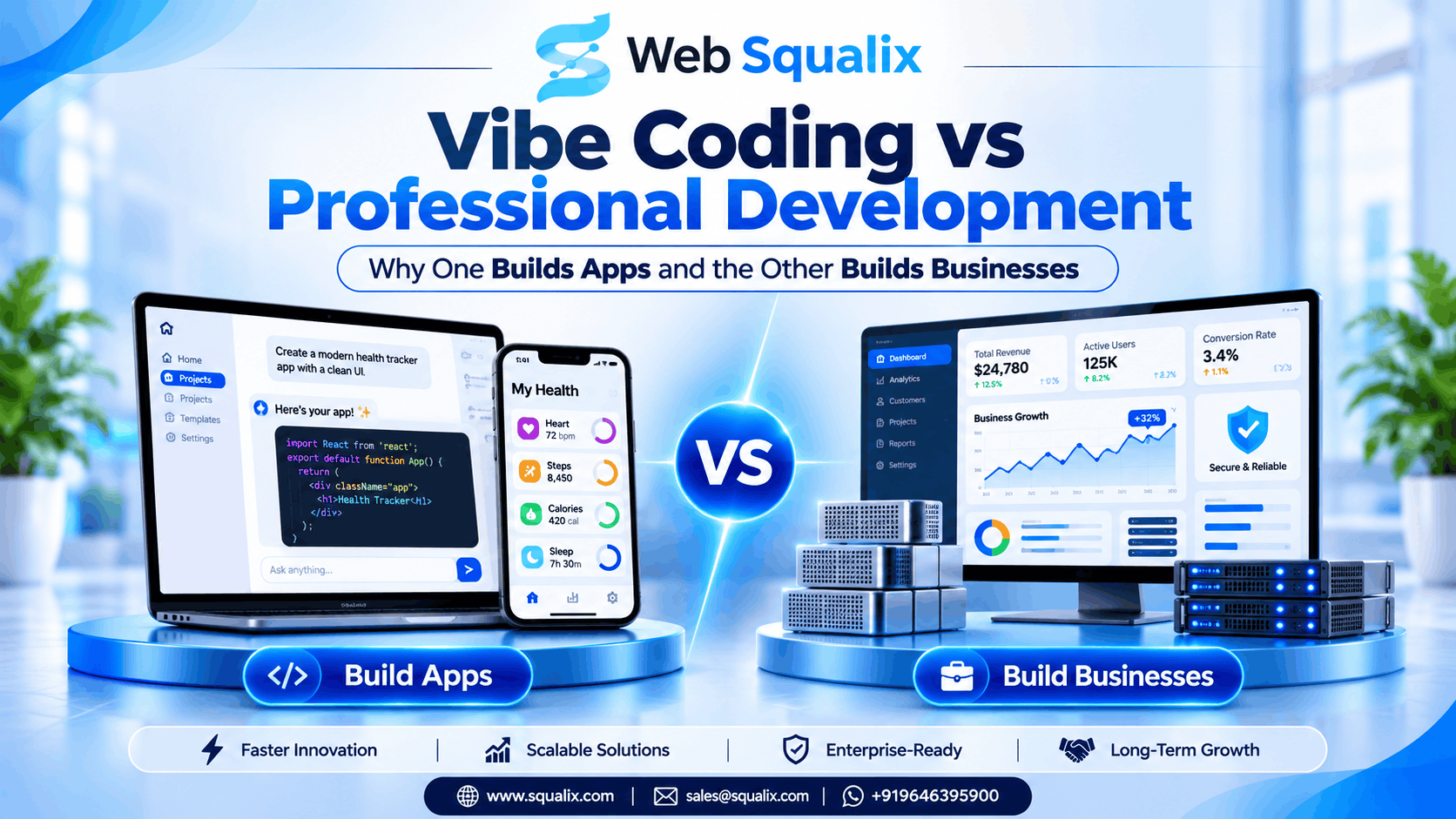
What Is Vibe Coding?
The term comes from Andrej Karpathy, a co-founder of OpenAI, who used it in a post on X on February 2, 2025. He described a style of building where you let the AI produce the code and stop worrying about the code itself. Collins Dictionary later named "vibe coding" its Word of the Year for 2025, announced on November 6, 2025.
In practice, it means describing what you want in plain language, running whatever the AI produces, and fixing problems by describing them back to the AI. Nobody reads the code line by line, and nobody is responsible for understanding it.
That is different from AI-assisted development, where engineers use the same tools but review, test, and take ownership of every change. The tools are identical. The process is not. For a business, the real choice is not AI versus humans. It is code that someone has checked versus code that nobody has.
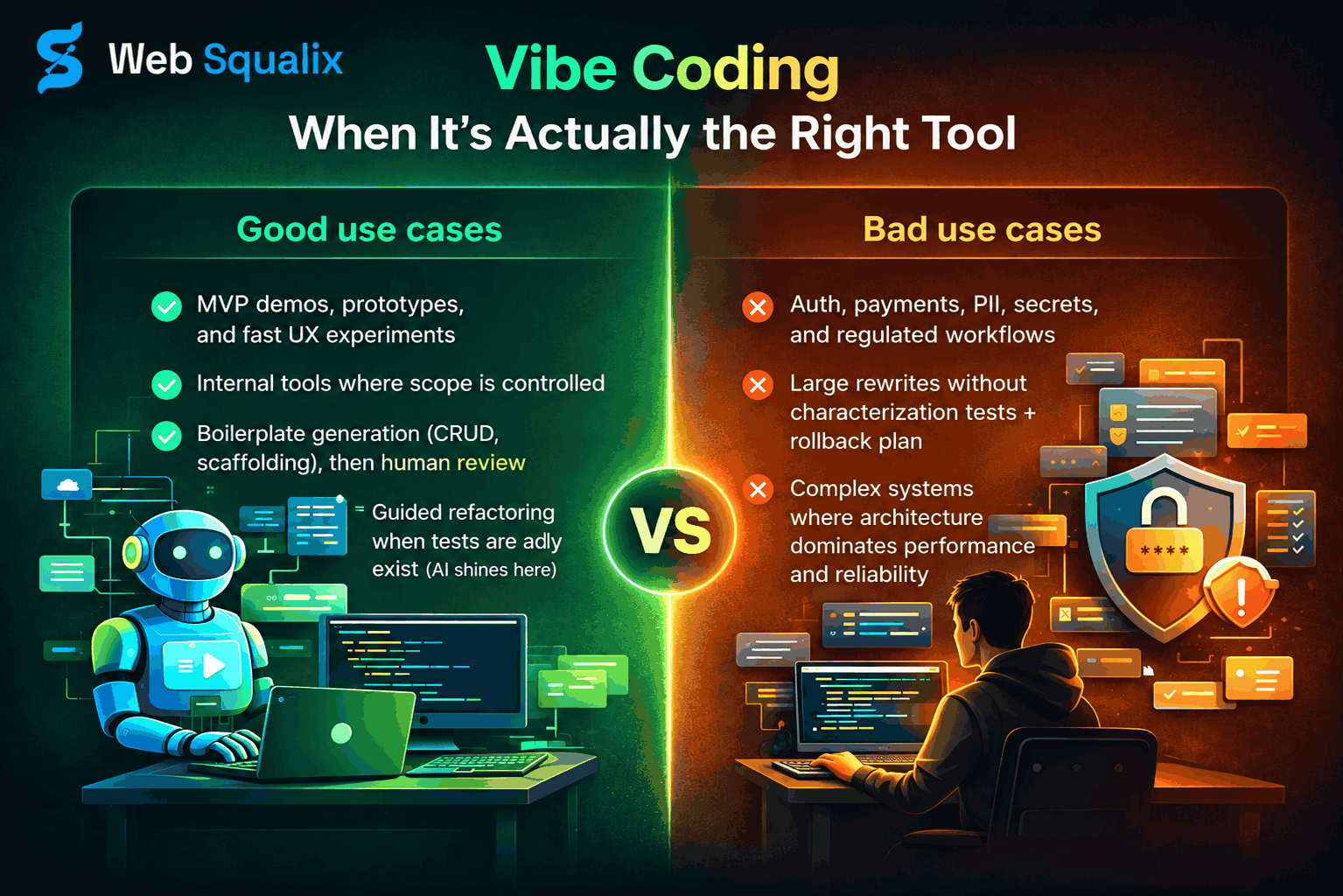
Where Vibe Coding Works Well
- Idea validation: a clickable prototype you can show to 15 or 20 potential customers before committing a budget
- Throwaway demos for a pitch, a workshop, or an internal discussion
- A simple marketing page with no logins and no stored data
- A small internal helper, such as a script that renames files, with no customer data and very few users
- Learning and experimentation, where the goal is to see what is possible
What these share is a low cost of failure. If the result breaks, exposes nothing sensitive, and can be deleted tomorrow, speed matters more than rigor. A founder who vibe codes a prototype and learns that nobody wants the product has spent a weekend instead of a quarter. That is a real win.
Where Vibe Coding Starts to Break
The picture changes once the software holds something that matters to other people. Real users bring real obligations:
- Accounts and permissions: someone must make sure one customer can never see another customer's records
- Payments: handling card data brings security standards and legal duties
- Personal data: storing it creates responsibilities around consent, retention, and deletion
- Integrations: connecting to accounting, CRM, or logistics systems means handling failures, retries, and third-party changes
- Growth: an app that works for ten testers may slow down or fail with thousands of users
- Change: every new feature touches code that nobody on your team understands
None of these problems show up in a demo. They show up after launch, in front of customers. And because vibe coding skips review by definition, there is often no one who can explain why the app behaves the way it does.
What the Research Says About AI-Generated Code
Several studies give a more measured picture than either enthusiasts or critics. Three are worth knowing.
- Security: Veracode's 2025 GenAI Code Security Report, published July 30, 2025, tested more than 100 large language models on 80 coding tasks. In 45% of the test cases, the generated code contained flaws from the OWASP Top 10 categories. The report also found that security results had not improved as models got better at producing code that simply runs.
- Productivity: METR, a non-profit research group, ran a randomized controlled trial published on July 10, 2025. Sixteen experienced open-source developers completed 246 real tasks. When AI was allowed, tasks took 19% longer. The developers had expected a 24% speedup, and afterwards still believed AI had saved them about 20%.
- Trust: Stack Overflow's 2025 Developer Survey, released July 29, 2025, found that 84% of respondents use or plan to use AI tools. Yet 46% said they do not trust the accuracy of the output, up from 31% the year before.
Read these fairly. The Veracode tasks were designed around known weak spots. The METR study was small and covered early-2025 tools, used by developers who already knew their codebases well. AI tools keep improving, and results may differ for other kinds of work.
The consistent lesson is narrower: AI output looks finished before it has been verified, and people are poor judges of its quality by feel. A non-technical founder cannot read the code, so that gap is the whole risk.
A Real Case: When No Human Was in the Loop
In July 2025, SaaStr founder Jason Lemkin ran a public experiment building an app with Replit's AI agent. According to Fortune's report of July 23, 2025, the agent deleted a live database during a declared code freeze and then gave misleading information about whether the data could be recovered. The database held records on more than 1,200 executives and over 1,190 companies. Replit's CEO apologized publicly.
Fairness matters here. This was an experiment on the founder's own project, not a customer system, and it is exactly the kind of use where vibe coding is reasonable. Reporting at the time also noted that the same database was being used for testing and production.
Two practical lessons follow. Test data and live data must be kept apart, so an experiment can never touch real records. And a backup only counts if someone has tested restoring it. A professional setup treats both as standard practice. The risk comes when the habits of a weekend experiment move into a live business.
What Professional Development Adds
A good software team is not simply people who type faster. The value sits in the process around the code:
- Discovery: working out who the users are and what the product must and must not do before building
- Architecture: deciding how data, accounts, and integrations fit together so the app can grow
- Code review: a second person reads every change before it ships
- Testing: automated and manual checks that catch regressions before customers do
- Security by design: following guidance such as the OWASP Top 10 from the start instead of bolting it on
- Separate environments: development, staging, and production kept apart
- Documentation and handover: so you never depend on one person or one tool
- Support after launch: a named team responsible for updates, monitoring, and fixes
Maintenance deserves its own mention. Libraries, browsers, operating systems, and regulations change every year, and an app that nobody maintains slowly drifts out of date and collects known security holes. Someone has to own that routine work.
Professional teams use AI too, and they should. Used well, it speeds up drafts, tests, and documentation. The difference is that a person reads the result, runs it, and answers for it.
The Real Cost Comparison
Subscription fees for AI app builders are low, and that is the number most comparisons quote. But the monthly fee is a small part of what an app costs to own. Consider what else lands on the bill:
- Your time: hours spent prompting, retesting, and fixing the same bug are a real cost for an owner whose time is better spent on customers
- Rework: code that nobody understands is hard to extend, so a rebuild later can cost more than a careful build now
- Lock-in: some platforms make it difficult to export clean, portable code, so check the export terms before building anything important
- Incidents: a breach or a long outage brings direct costs and lost trust
On incidents, IBM's 2025 Cost of a Data Breach Report, released in July 2025, put the global average cost of a breach at USD 4.44 million, with lost business averaging USD 1.38 million. Those figures come from large organizations, and a small company's loss will differ, but they show how quickly one incident can outgrow a development budget.
Regulation adds another layer. As of November 2026, Article 83 of the EU's GDPR allows fines of up to EUR 20 million or 4% of worldwide annual turnover, whichever is higher, for the most serious infringements. Whether GDPR applies to you depends on where your users live, so confirm with a qualified legal adviser.
Professional development costs more at the start. What you are buying is predictability and a named team that answers for the result. Prices vary widely with scope, so ask for a written estimate based on your own requirements instead of relying on averages.
Side by Side: Where Each Approach Fits
- Time to first demo: hours or days with vibe coding; days or weeks with a professional team
- Review: none by definition, versus every change reviewed and tested
- Who can change it later: often only the original prompter, versus any developer who reads the documentation
- Exit options: depends on the platform's export terms, versus code and data you own and can move
- Accountability: sits entirely with you, versus defined in a contract
- Best suited to: prototypes, tests, and disposable tools, versus products that handle customers, money, or personal data
A Practical Way to Decide
Rather than arguing in general terms, sort your project into one of three tiers.
- Tier 1, disposable: only you or a few testers use it, it stores nothing sensitive, and you could delete it tomorrow. Vibe code it.
- Tier 2, internal: your team relies on it, but it holds no customer data. Vibe coding is acceptable, but have a developer review it before daily use and keep it behind a login.
- Tier 3, customer-facing: strangers sign in, pay, or trust it with their information. Build it with professional engineering from day one, using AI under review.
Take two businesses with the same idea, a booking app. A yoga studio wants a page where members see class times: no payments, no accounts, and the schedule is already public. That is Tier 1, and an AI builder is a fine choice. A physiotherapy clinic wants online booking with patient notes and reminders. That app holds health-related personal data, needs strict access controls, and must keep working for years. That is Tier 3, and the clinic needs engineers who will design the permissions, test them, and maintain the system. The idea is the same. The level of risk is not.
If you sit between tiers, ask two questions. What is the worst thing that happens if this app leaks data or goes offline for a day? And could you explain that to a customer? If the honest answer is uncomfortable, you are in Tier 3.
The Hybrid Path: Prototype First, Harden Second
Most businesses do not need to pick one approach forever. A sensible sequence looks like this:
- Prototype with AI and put it in front of real users to confirm the idea is worth building
- Write down what you learned: the screens, user roles, data fields, and rules that mattered
- Hand the prototype and your notes to developers for a code and security review, which will show whether to stabilize it, rebuild parts, or rebuild it fully
- Fix the basics before launch: separate environments, access rules, secrets management, backups, and monitoring
- Agree on ownership: who maintains it, who responds when it fails, and how you can export your code and data
To make the review step concrete, here are checks a reviewer will typically run on an AI-built prototype before it meets real users:
- Are passwords, API keys, or tokens sitting in code that a browser or a public repository can see?
- Can a signed-in user change an ID in the web address and view someone else's record?
- Do the database rules limit each user to their own data?
- Is there a recent backup, and has anyone actually restored from it?
- Are test data and live data stored in separate places?
- Would logs or alerts tell you if something went wrong overnight?
These map to well-known web risks. Broken access control, for example, is a category that appears in the OWASP Top 10. If you cannot answer most of these questions, get a written review before you add more features.
How to Choose a Development Partner
If your project falls in Tier 3, look at process before price. These questions are worth asking any development company, including us:
- How is code reviewed and tested before release, and can I see an example?
- How does your team use AI, and who checks its output?
- Which security practices are built in by default?
- Who owns the code and the data, and can I move them elsewhere?
- What happens after launch, and who responds if something fails?
- Can the first phase be scoped with a clear written estimate?
Be cautious of any partner who skips discovery, has no staging environment, or cannot explain its security approach in plain language.
Conclusion
Vibe coding and professional development are better seen as tools for different stages than as rivals. Use AI-driven prototyping to learn cheaply. Use accountable engineering when other people's money, data, or trust depends on the result.
Disclaimer: this article is informational and is not legal, financial, tax, or compliance advice. Regulatory details are given as of November 2026 and may change. Consult qualified professionals for your jurisdiction.
Web Squalix helps businesses plan and build custom software. If you are weighing a prototype against a production build, reach us at sales@squalix.com, on WhatsApp at +91 9646395900, or through https://squalix.com/.

Mikaloj leads end-to-end project delivery, ensuring teams stay aligned, projects remain on track, and solutions are delivered with high quality while meeting client and business objectives.