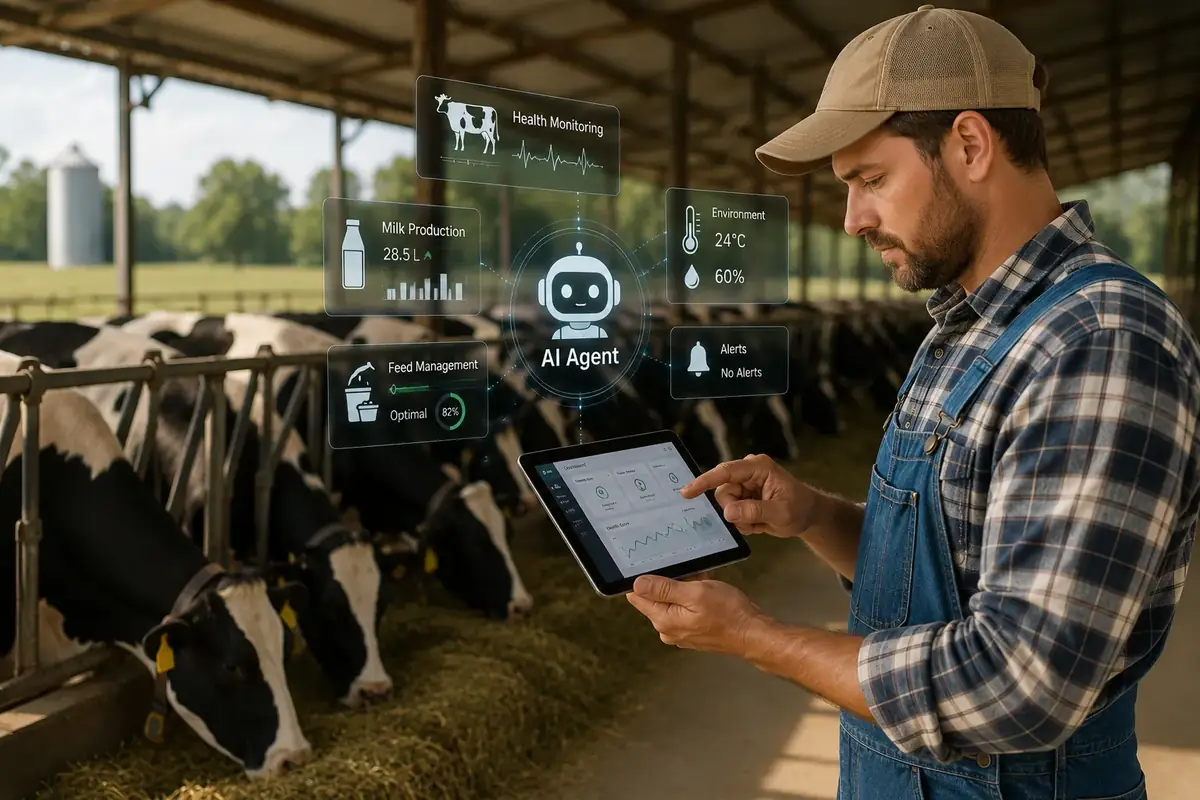
A dairy farmer's day used to start and end with a walk through the barn, eyes scanning for anything off a cow standing a little too still, feed left untouched, a gate that didn't latch right. That instinct still matters. But it's no longer the only thing standing between a healthy herd and a costly problem. Over the past few years, AI agents have quietly moved from research papers into actual barns, actual feed schedules, and actual milking parlors. They're not replacing the farmer's judgment — they're giving it a lot more to work with.
This shift matters because dairy farming runs on thin margins and thinner sleep schedules. A missed illness, an inefficient feed mix, or a delayed maintenance call can cost a farm far more than the software meant to prevent it. Here's what AI agents actually are, the specific problems they solve on a dairy operation, the technology stack behind them, and where this is all heading over the next few years.
What Are AI Agents?
An AI agent is software that doesn't just follow a fixed script it observes data, makes a judgment call, and acts on it, then adjusts based on what happens next. That's the core difference between an AI agent and traditional automation. A thermostat that switches on a fan at a set temperature is automation. A system that learns a specific cow's normal temperature range, notices a subtle deviation days before a human would catch it, and flags it for review that's an agent.
The four things that make an agent, an agent
- Learning — the system builds a model of what 'normal' looks like for a herd, a barn, or even an individual animal, rather than relying on one-size-fits-all thresholds
- Decision making — it weighs multiple signals at once, like temperature, movement, and feed intake, instead of triggering on a single metric
- Automation — once a decision is made, it can trigger an action directly, such as adjusting a feed dispenser or sending an alert to a farm manager's phone
- Continuous improvement — the model updates as more data comes in, so its predictions get sharper over a season rather than staying static
None of this requires a farmer to understand machine learning. The value shows up as a notification that says, essentially, 'check on cow 214' — hours or days before a visible symptom would have appeared.
Challenges Modern Dairy Farmers Face
Before getting into solutions, it's worth being honest about why this technology found an audience in dairy farming specifically. The pressures are real and they're compounding.
- Labor shortages — skilled farmhands who can spot early signs of illness are harder to find and retain every year
- Rising operational costs — feed, energy, and equipment maintenance costs have climbed steadily, squeezing already-tight margins
- Animal health monitoring — a herd of even a few hundred cows makes manual, round-the-clock observation impractical
- Feed optimization — overfeeding wastes money, underfeeding hurts yield and welfare, and getting this balance right by hand is mostly guesswork
- Milk quality and disease detection — subclinical conditions like mastitis often show no obvious symptoms until milk quality or yield has already dropped
- Weather uncertainty — heat stress and shifting weather patterns directly affect milk production and herd comfort
- Sustainability goals — farms face growing pressure to reduce water use, methane output, and overall environmental impact
Each of these problems shares a common thread: they're all about noticing a pattern early and reacting fast. That's precisely the kind of task AI agents are built for.
How AI Agents Help Dairy Farmers
The most useful AI agents on a dairy farm today don't try to do everything. They focus on specific, high-value jobs and do them continuously, without fatigue.
Automated herd monitoring and early illness detection
Sensors on the cow and cameras in the barn keep track of things like movement, how much she's chewing her cud, and body temperature. All of that feeds into a system that learns what's normal for that specific animal — not just normal for a cow in general. So when something starts to shift, even slightly, it catches it long before anyone walking the barn would notice. That early warning matters most with things like mastitis or lameness, where getting to it a few days sooner can mean a much easier recovery — and a much smaller vet bill.
Heat detection and breeding timing
Timing breeding correctly has always been one of the trickiest parts of herd management. AI agents that monitor activity levels and physiological signals can identify the optimal breeding window far more reliably than visual observation alone, which directly improves conception rates.
Feeding optimization
Feed is usually the single largest recurring cost on a dairy farm. Agents that track individual animal intake, milk output, and body condition can recommend or automatically adjust feed mixes per group or even per animal, reducing waste while protecting yield. Instead of feeding every cow in a group the same ration regardless of how much milk she's actually producing, an agent can flag which animals are being over- or under-fed relative to their output, and adjust the mix accordingly. Over a season, even small corrections like this add up to meaningful savings.
Milk production forecasting
By analyzing historical yield data alongside feed, weather, and health signals, agents can forecast production trends for the coming days or weeks. That forecast helps farm managers plan logistics, staffing, and even sales commitments with more confidence.
Barn environment monitoring
A barn's temperature, humidity, and airflow aren't just comfort details — they show up directly in the milk tank and in how stressed the herd is. Instead of running ventilation on a timer, these systems watch actual conditions and adjust as they change. It's during heat waves that this really pays off: a few degrees' difference inside the barn is enough to hurt yield and put cows under real stress. Because the reaction happens in minutes, not after a staff member finally notices the barn's gotten warm, conditions stay steady across the whole herd, not just wherever someone last checked.
Predictive maintenance, inventory, and reporting
Milking equipment failure at the wrong moment can disrupt an entire day's operation. AI agents that monitor equipment usage patterns and sensor data can predict wear before a breakdown happens, scheduling maintenance proactively instead of reactively. Beyond the barn, agents also help manage feed inventory levels, generate compliance-ready reports, and build daily task schedules for farm staff — freeing up hours that used to go into spreadsheets and paperwork.
AI Technologies Behind Smart Dairy Farming
None of these use cases run on a single piece of technology. They're built from a stack of complementary tools working together.
- Machine learning — builds predictive models for health, yield, and breeding timing
- Computer vision — analyzes barn camera feeds to detect lameness, posture, or distress
- IoT sensors — capture real-time data on movement, temperature, and rumination
- Edge computing — processes sensor data locally in the barn for faster response times
- Cloud computing — stores historical data and runs heavier analytics across the whole herd
- Large language models — power natural-language dashboards farmers can simply ask questions of
- Generative AI — drafts reports, summarizes trends, and generates recommendations in plain language
- Digital twins — simulate barn conditions or herd scenarios before changes are made physically
- Robotics — automate physical tasks like feeding, cleaning, and milking
- Wearable livestock devices — track individual animal vitals and activity continuously
What ties all of this together is software — a system that can ingest sensor data, run it through models, and present clear, actionable recommendations. That's usually where a farm's existing setup falls short, and where custom software development becomes necessary rather than optional. Off-the-shelf farm software often can't account for a specific barn layout, herd size, or regional weather pattern, which is why more agriculture businesses are investing in tailored platforms built around their actual operations.
Benefits of AI Agents for Dairy Farming
- Higher milk production through better-timed feeding and early health intervention
- Lower operational costs by reducing feed waste and preventing equipment downtime
- Better animal welfare through continuous, non-invasive monitoring
- Faster decision making with real-time alerts instead of end-of-day observations
- Improved productivity as staff spend less time on manual checks and paperwork
- Reduced labor dependency during ongoing farmhand shortages
- Increased sustainability through more precise resource use
- Better regulatory compliance with automated, audit-ready reporting
- More consistent, data-driven operations across every shift, not just the most experienced staff
Challenges and Considerations
AI agents aren't a plug-and-play fix, and it helps to go in with clear eyes about the trade-offs.
- Initial investment — sensors, connectivity infrastructure, and software all require upfront spend before returns show up
- Connectivity — rural properties often have inconsistent internet access, which affects how much processing can happen in the cloud versus on-site
- Data privacy — farm and herd data is valuable and sensitive, so clear data ownership and security policies matter from day one
- AI training — models need enough historical data from a specific farm to become genuinely accurate, which takes time
- Farmer adoption — tools only help if the people using them trust the recommendations, which means interfaces need to be simple and transparent
- Ethical AI — automated health or breeding decisions should support a farmer's judgment, not silently override it
- Integration with legacy equipment — many farms run mixed generations of machinery, and new systems need to work alongside what's already installed
- Maintenance and cybersecurity — connected devices expand the attack surface, so ongoing monitoring and updates are non-negotiable
The Future of AI Agents in Dairy Farming
What we're seeing is a push toward more autonomy, not less. A few larger operations are already testing multi-agent setups — feeding, health monitoring, and equipment maintenance working together instead of each running in its own lane. Farm managers asking something like 'which cows need attention today?' in plain language and getting a useful answer back is starting to look realistic, not experimental. Meanwhile robotics keeps taking on more of the repetitive feeding and cleaning work, which frees people up to spend their judgment where it actually matters.
Longer term, expect climate-smart agriculture to lean more heavily on predictive models that account for weather volatility, and a growing role for what some are already calling AI veterinarians — diagnostic support systems that triage animal health concerns before a human vet is even called. The farmer doesn't get replaced in any of this. What changes is where their time goes — less of it spent watching for trouble, more of it spent actually deciding what to do once something's been flagged.
It's also worth noting that adoption won't look the same everywhere. Larger operations with more capital will likely deploy multi-agent systems first, while smaller farms are more likely to start with a single, focused tool — a heat-detection wearable or a feed-optimization app — before expanding. Software providers who understand that difference, and build systems that can scale up or down with a farm's size, will end up shaping how quickly this technology actually spreads through the industry rather than staying limited to the largest players.
Conclusion
AI agents are transforming dairy farming not by replacing the farmer's instincts, but by extending them catching what a single pair of eyes physically can't watch for around the clock. The farms benefiting most today are the ones treating this as a long-term operational upgrade: starting with one clear problem, like early illness detection or feed optimization, and building outward from there. Owning the sensors or the AI model was never really the point the real differentiator is a software layer built around the specific realities of a given farm. And if you're evaluating how to bring AI agents into your own operation, our AI and custom software development teams can help you get to a working system faster than most early adopters manage on their own.

Mikaloj leads end-to-end project delivery, ensuring teams stay aligned, projects remain on track, and solutions are delivered with high quality while meeting client and business objectives.