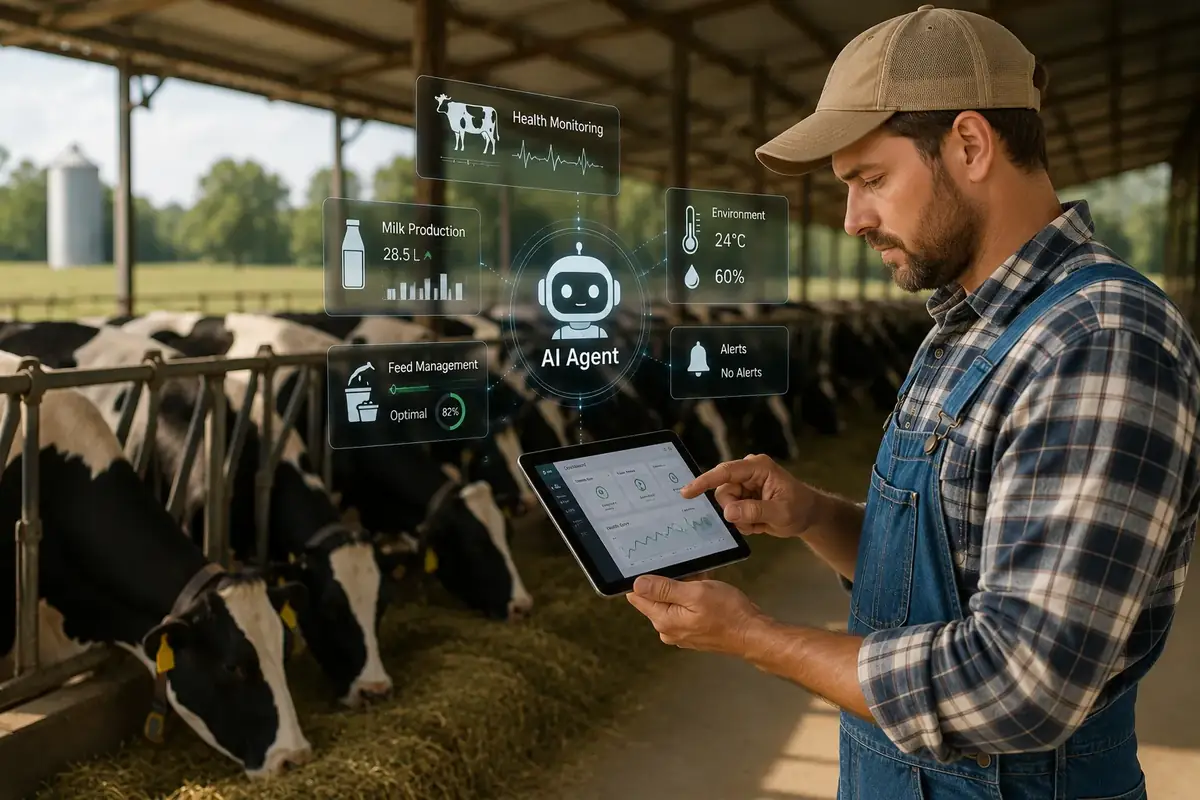
What Is AI in Agriculture?
AI in Agriculture is the use of machine learning, computer vision, and data analytics to help farmers and agribusinesses make better decisions about crops, soil, water, and livestock. It's less a single product and more a layer that sits on top of the tools farms already use: sensors in the field, cameras on drones, satellite images, weather stations, and farm equipment.
On its own, none of that data means much. A soil moisture reading is just a number, a satellite image is just a picture. What AI does is connect those pieces, compare them against patterns learned from thousands of similar fields and seasons, and turn them into something usable: irrigate this block tomorrow morning, this patch shows early signs of blight, expected yield for this field is trending below last season. That's the practical definition — AI in Agriculture takes scattered data and turns it into a decision a farmer can act on the same day.
- Sensors and IoT devices — soil moisture, temperature, and nutrient readings collected continuously
- Satellite and drone imagery — crop health and field conditions viewed from above
- Machine learning models — trained on historical yield, weather, and pest data to spot patterns
- Computer vision — identifying disease, weeds, or ripeness from images in near real time
- Analytics dashboards — turning all of the above into recommendations a farmer can act on
How Artificial Intelligence Is Transforming Farming in 2026
What's actually changed isn't any one piece of hardware or software. It's timing. Most farmers used to find out about a problem after it had already taken hold — you'd walk a field once or twice a week, and by the time you spotted the pest damage or the dry patch, it had usually spread further than you'd like. Continuous monitoring closes that gap. The same field gets checked constantly instead of occasionally, so the warning signs show up while there's still a small, cheap fix available rather than a bigger, more expensive one.
That shift shows up across almost every part of the operation. Crop monitoring now runs in the background instead of requiring a truck and a pair of boots for every check. Soil analysis has moved from occasional lab samples to continuous sensor readings that show how conditions change hour by hour. Weather prediction models, tuned to a specific farm's location and history, give more useful lead time than a general regional forecast. Irrigation management can respond to actual soil moisture instead of a fixed schedule, which matters both for crop health and for water costs.
Computer vision is where pest and disease detection gets a real boost — a camera picks up on the faint color shift or texture change on a leaf that's easy to miss when you're walking a field from a few feet away. Yield prediction works a bit differently: it pulls together weather, soil, and past-season data to give a farm a reasonably honest read on what the harvest will look like, well before it actually happens. Then there's the machinery side. Automation has crept into the equipment itself, with tractors and harvesters now handling steering, spraying, or cutting with a lot less hands-on input than before. Livestock gets a version of the same treatment — sensors track movement and feeding patterns, and an unusual pattern there is often the first hint that an animal isn't well. And further downstream, AI is doing quieter work matching what actually comes off the field with demand, storage space, and transport schedules, which is mostly about cutting down the guesswork that leads to spoiled or wasted product.

Top Applications of AI in Agriculture
It helps to look at where AI is actually being put to work rather than treating it as one big abstract trend. These are the applications showing up most often on real farms and in the agtech platforms serving them.
- AI-based crop disease detection — cameras and image models flag leaf discoloration, spotting, or wilting patterns tied to specific diseases, often before symptoms are visible to the naked eye at a distance
- Precision farming — treating small zones of a field differently based on their specific soil and moisture conditions, instead of applying the same input across an entire field
- Smart irrigation — adjusting water delivery based on real soil moisture and weather forecasts rather than a fixed calendar
- AI-powered drones — flying scheduled routes to capture imagery, spray targeted areas, or scout for problems across large acreage quickly
- Satellite and remote crop monitoring — tracking crop health across an entire operation without a single site visit, useful for farms managing multiple distant plots
- Predictive analytics — forecasting yield, pest pressure, or disease risk based on current and historical conditions
- Automated agricultural machinery — tractors and harvesters that use sensors and mapping to reduce manual steering and repetitive tasks
- Livestock health monitoring — wearable and camera-based systems that track feeding, movement, and behavior to catch illness early
- Harvest prediction — estimating the right harvest window based on crop maturity data, helping coordinate labor and logistics in advance
None of these tools work in isolation. A farm running smart irrigation alongside crop monitoring gets more value from both, since the irrigation system can factor in the crop stress data the monitoring system is already collecting.
Benefits of AI in Farming
The appeal of AI in Agriculture comes down to a fairly simple idea: better information, used earlier, tends to lead to better outcomes. That plays out in a few practical ways.
- Higher crop productivity — decisions based on current field conditions rather than guesswork or fixed schedules
- Reduced water usage — irrigation that responds to actual soil moisture instead of a default routine
- Lower operational costs — targeted treatment of pests, disease, or nutrient gaps instead of blanket application
- Better resource management — clearer visibility into which fields or zones need attention and when
- Early disease detection — catching problems while treatment is still cheap and effective
- Reduced crop losses — spotting stress signals before they turn into a failed section of a field
- Improved decision-making — recommendations grounded in real data rather than instinct alone
- Increased farm profitability — the combined effect of lower input waste and fewer losses
- More sustainable farming practices — less over-application of water, fertilizer, and pesticide
It's worth being honest about the limits here too. AI tools improve the quality of information a farmer has, but they don't eliminate the underlying risks of farming — weather is still unpredictable, and no model can promise a specific yield increase for every operation. The realistic value is fewer surprises and faster response, not guaranteed results.
AI, Precision Agriculture & Smart Farming
AI in Agriculture, precision agriculture, and smart farming get used almost interchangeably, but it helps to see how the pieces fit together. Precision agriculture is the practice of managing a field at a finer level of detail — treating different zones differently instead of the whole field the same way. Smart farming is the broader idea of running a farm using connected devices and data. AI is the layer that makes both of those practical at scale.
GPS-guided equipment can plant, spray, or harvest along precise lines, cutting down on overlap and waste. IoT sensors scattered across a field feed a constant stream of soil and moisture data. Drones capture imagery that would take days to collect on foot. On their own, each of these produces more data than a person could reasonably review field by field, every day. AI is what processes that volume of information fast enough to be useful — turning a few thousand sensor readings and a stack of aerial images into a short list of fields that need attention this week. Precision agriculture and smart farming set the stage; AI is what makes the data usable at the pace a growing season actually demands.
Challenges of Implementing AI in Agriculture
Adopting AI in Agriculture isn't as simple as installing an app. There are real, practical hurdles that farms and the companies building for them need to plan around.
- High initial investment — sensors, drones, and connected equipment carry upfront costs that take time to pay back
- Lack of technical expertise — running and interpreting these systems requires skills that differ from traditional farm operations
- Internet and connectivity limitations — many farms sit in areas with limited or unreliable connectivity, which complicates real-time data collection
- Data quality and availability — models are only as good as the data feeding them, and inconsistent or incomplete data limits accuracy
- Farmer adoption — trusting a dashboard recommendation over decades of hands-on experience takes time and a track record of the tool being right
- Maintenance and technical support — sensors and equipment need upkeep, and rural areas don't always have easy access to technical support
- Data privacy and ownership — questions about who owns farm data and how it can be used or shared remain unsettled in many markets
- Integration with existing equipment — older machinery and legacy software don't always connect cleanly with newer AI platforms
None of these challenges are reasons to avoid AI in Agriculture altogether. They're reasons to plan an implementation in stages, starting with the tools that solve a farm's most immediate problem rather than trying to digitize an entire operation at once.

Future of Artificial Intelligence in Agriculture
Looking ahead from where things stand in 2026, the trajectory for AI in Agriculture points toward tools becoming more autonomous, more personalized, and more tightly connected to the rest of the food supply chain.
- AI-powered autonomous farming — equipment capable of handling more of the planting-to-harvest cycle with less direct supervision
- Generative AI farming assistants — conversational tools that let a farmer ask plain-language questions about their fields and get a direct answer
- Predictive crop management — models that plan an entire season's inputs based on forecasted conditions rather than reacting week to week
- Computer vision — increasingly accurate at distinguishing between crop varieties, growth stages, and specific disease types
- Robotics — specialized machines for tasks like selective harvesting that are difficult to automate with traditional equipment
- Digital twins for farms — virtual models of a field or operation used to test decisions before applying them in the real world
- Climate-smart agriculture — tools that help farms adapt practices to shifting weather patterns and reduce environmental impact
- AI-powered agricultural marketplaces — platforms that match crop supply with buyer demand more efficiently
- Edge AI and IoT — processing data directly on field devices, reducing the dependence on constant connectivity
- Personalized recommendations — advice tuned to a specific farm's soil, climate, and history rather than generic best practices
The realistic version of this future isn't a fully robotic farm with no human involvement. It's a farm where the person making decisions has dramatically better information, and where routine, repetitive tasks are handled by machines so people can focus on the judgment calls that still need a human behind them.
Conclusion
Farming has always involved managing uncertainty — weather, pests, markets, all of it. What AI in Agriculture changes isn't the uncertainty itself, but how early a farm can see it coming and how precisely it can respond. That's the real shift underway in 2026: a move from decisions made on routine and instinct toward decisions grounded in continuous, field-level data. It's not a dramatic overnight change, but season by season, it adds up to farms that lose less, waste less, and adapt faster.
For agribusinesses, cooperatives, and technology teams exploring what a custom AI-powered farming platform, smart agriculture dashboard, or IoT-connected monitoring system could look like for their own operation, Web Squalix works with clients building exactly this kind of software — from field sensor integration to predictive analytics and automation tools tailored to how a specific farm actually runs.

Mikaloj leads end-to-end project delivery, ensuring teams stay aligned, projects remain on track, and solutions are delivered with high quality while meeting client and business objectives.