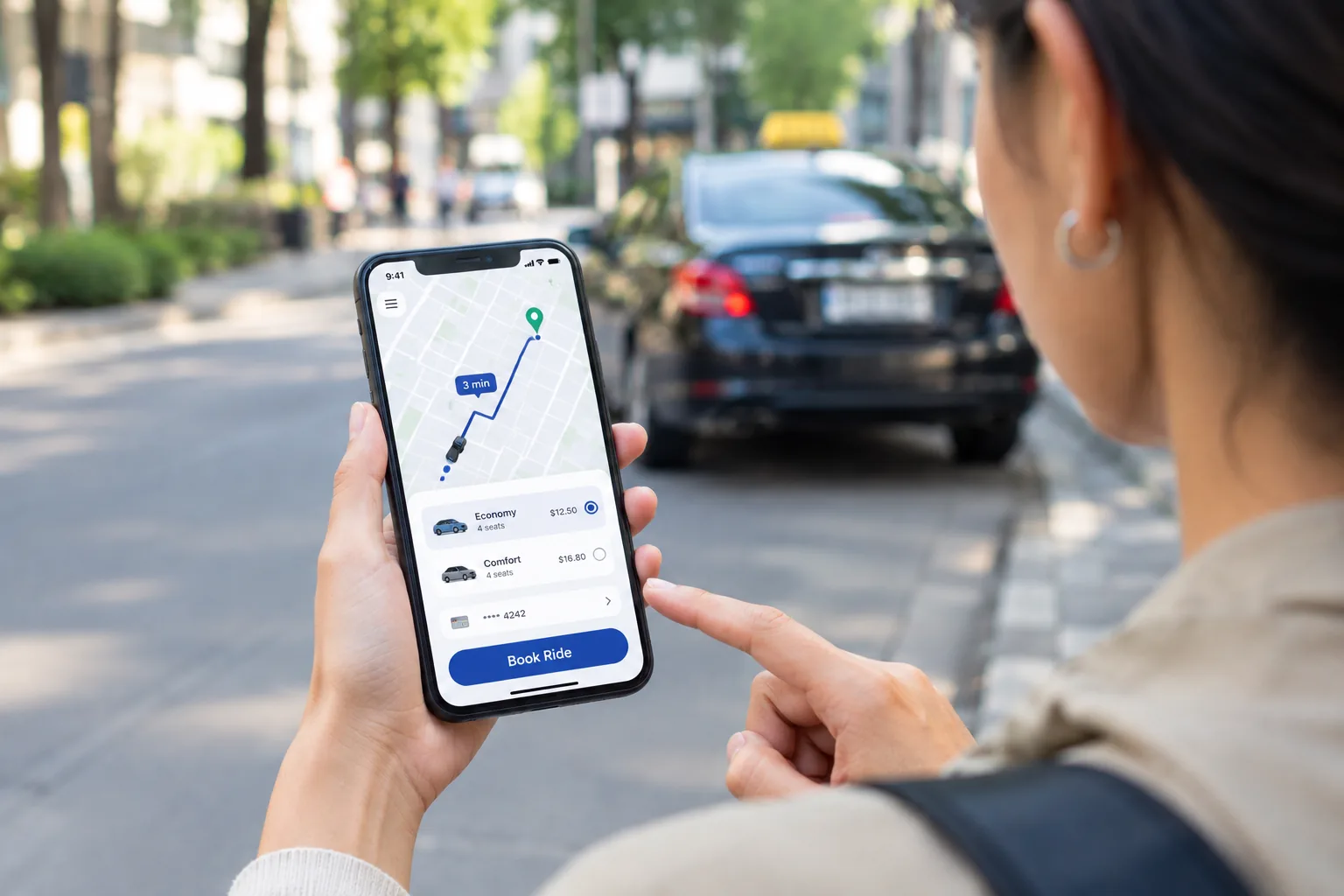
Before committing budget and time to on demand app development, it's worth understanding both where the technology is heading and how similar platforms actually make money. Get either piece wrong, and even a well-built app can struggle to find traction or profitability. This article walks through the trends shaping on-demand apps this year, the business models built around them, and the monetization approaches that have proven durable across different industries.
What Is On-Demand App Development?
An on-demand application connects a customer who needs something right now — a ride, a meal, a repair, a consultation — with someone who can provide it, usually within minutes or hours rather than days. The defining feature isn't the industry; it's the immediacy and convenience of the transaction. Most on-demand platforms follow a similar structural flow: the customer requests a service, the platform matches that request with an available provider, the provider fulfills it, and the transaction is tracked and paid for digitally from start to finish.
- Food and grocery delivery
- Taxi and ride-hailing services
- Home services (cleaning, repairs, maintenance)
- Healthcare and telemedicine
- Beauty and wellness bookings
- Logistics and courier services
- On-demand professional services (legal, tutoring, consulting)

Each of these industries has its own operational quirks, but the underlying software needs — booking, matching, tracking, and payment — are largely the same. That's why many businesses turn to specialized on demand app development services rather than building this infrastructure from scratch, since a lot of the groundwork has already been solved in other verticals.
Key On-Demand App Development Trends in 2026
Technology choices for on-demand apps have matured. It's no longer just about having a booking system and a map — customers expect a level of intelligence and responsiveness that older platforms didn't offer. Here's what's actually shaping development decisions this year.
- AI-powered personalization improves recommendations, search relevance, demand prediction, and customer support responses.
- Real-time tracking and location intelligence give customers live status updates and accurate arrival estimates, reducing support tickets and building first-time trust.
- Smarter automation handles provider assignment, shift scheduling, reminders, and basic support, letting small teams manage far larger transaction volumes.
- Digital payments and flexible checkout — wallets, saved cards, region-specific methods, subscription billing — reduce drop-off at the point of purchase.
- Predictive analytics lets platforms anticipate demand spikes and allocate resources ahead of time instead of reacting after the fact.
- Conversational interfaces, including chatbots and voice tools, now handle a meaningful share of routine support and service discovery.
- Scalable cloud infrastructure, well-documented APIs, and caching layers allow platforms to absorb traffic spikes without a complete rebuild.
None of these trends work in isolation — they reinforce each other. Real-time tracking is only useful if the backend infrastructure can support it at scale, and predictive analytics only matters if the automation layer can act on those predictions quickly.
How On-Demand Apps Are Changing Business Models
Beyond the technology itself, on-demand platforms have changed how service businesses are structured. Many companies that used to operate as single-location businesses now operate as platforms connecting multiple independent providers to a broad customer base.
- Platform-based businesses build and maintain the technology layer connecting supply and demand, rather than delivering every service directly.
- Marketplace models let multiple providers compete for the same customer base within a single app.
- Multi-sided platforms create value for at least two distinct groups — customers and providers — and balance the needs of both.
- Service aggregation brings several related services together under one app instead of specializing in just one.
- Hyperlocal services prioritize speed and proximity within a tight geographic area over broad reach.
- Digital-first service delivery moves the entire customer journey, from discovery to feedback, inside the app.
Choosing which of these models fits a given business is a decision that should come before development begins, not after. It affects everything from the features that matter most to how on demand app development services should be scoped and prioritized.
Popular Monetization Strategies for On-Demand Apps
Getting the technology right doesn't automatically mean the business will be profitable. Monetization has to be designed deliberately, and it's often the part founders underestimate.
Commission-Based Model
The platform takes a percentage of each transaction completed through the app. This is the most common model for marketplaces because it aligns platform revenue with actual usage. It works best for high-volume, lower-value transactions like food delivery or ride-hailing, though providers can be sensitive to commission rates.
Subscription Model
Customers or providers pay a recurring monthly or yearly fee for access or premium benefits, such as reduced fees or priority booking. This suits platforms with repeat, predictable usage, like grocery delivery, though it requires enough perceived value to justify ongoing payment.
Service or Delivery Fees
A flat or variable fee charged for the convenience of the service itself, separate from the underlying product or service cost. It's transparent to customers but can become a friction point if perceived as too high relative to order value.
Featured Listings and Promotions
Providers pay to appear higher in search results or featured sections. This works well on platforms with many competing providers in the same category, but needs careful balance so paid placement doesn't undermine result relevance.
Advertising
Third-party or in-platform ads generate revenue without directly charging customers or providers. This depends on high daily engagement, and poorly targeted ads can hurt the user experience if left unmanaged.
Freemium / Premium Features
Basic functionality stays free while advanced features — faster support, detailed analytics, premium booking slots — are paid. This lowers the barrier to initial adoption but requires clear differentiation to drive upgrades.
Dynamic Pricing
Prices adjust based on demand, availability, location, or timing, similar to how ride-hailing platforms price peak hours. It helps balance supply and demand in real time but needs to be communicated transparently, or it risks damaging customer trust.
How to Choose the Right Business Model for Your On-Demand App
There's no universal best model — the right choice depends on the specifics of the business. Before locking in a monetization approach, it's worth evaluating several factors together rather than any one in isolation.
- Target audience — price-sensitive customers respond differently than convenience-driven ones
- Industry — some sectors, like healthcare, have regulatory constraints on pricing models
- Customer acquisition cost — high costs often favor models that maximize lifetime value
- Average order value — low-value, high-frequency transactions favor commissions; high-value, infrequent ones favor flat fees
- Service frequency — frequent usage supports subscriptions; occasional usage may not
- Competition, operational expenses, and provider commission rates
- Customer retention, scalability, and local market demand patterns
A practical approach is to start with one primary revenue stream, validate it with real usage data, and layer in secondary streams once the core model is proven. Trying to monetize through five different channels on day one usually creates more complexity than revenue.
Essential Features for a Modern On-Demand App
Feature scope should be driven by the business model chosen, not the other way around. That said, most on-demand platforms need functionality across three connected apps or panels.
Customer App
- Registration and login
- Service discovery, search, and filters
- Booking and scheduling
- Real-time tracking
- Digital payments
- Order or booking history, ratings, and reviews
- Push notifications and customer support access
Service Provider / Partner App
- Profile and credentials management
- Availability and scheduling controls
- Booking and job management with location tracking
- Earnings and payout tracking
- Notifications and service history
Admin Panel
- User and provider management
- Booking oversight and payment reconciliation
- Commission and payout management
- Analytics, reporting, and content management
| Layer | Common Choices | Why It Matters |
|---|---|---|
| Frontend | React Native, Flutter | Cross-platform reach without maintaining separate native codebases |
| Backend | Node.js | Handles high volumes of concurrent, real-time requests efficiently |
| Database | MongoDB, PostgreSQL | Flexible or relational schema depending on data structure needs |
| Cloud | AWS, Google Cloud, Azure | Scalable infrastructure for tracking, matching, and notifications |
| Maps & Location | Google Maps API, Mapbox | Live tracking, route optimization, service-area mapping |
| Payment Gateway | Stripe, Razorpay, PayPal | Secure, PCI-compliant digital transactions |
| Analytics | Mixpanel, custom dashboards | Tracks booking funnels, provider performance, retention |
It's tempting to build every feature imaginable at launch, but that often delays release and increases cost without adding proportional value. Web Squalix typically recommends launching with the features that directly support the chosen monetization model and business flow, then expanding based on actual user feedback rather than assumptions made before launch.
How an On-Demand App Development Company Can Help
Working with an experienced on demand app development company can reduce a lot of the technical risk that comes with building this kind of platform from the ground up. A capable development partner typically supports the full lifecycle of the product — business and requirement analysis, UI/UX design, mobile and backend development, API and payment integration, testing, security, cloud deployment, and post-launch support.
The value of an experienced team isn't just writing code — it's having already solved many of the operational problems, like matching algorithms, payment reconciliation, and provider verification workflows, that a first-time platform builder would otherwise have to figure out from scratch. Web Squalix approaches these projects with that operational experience built in, though no development partner can guarantee business success on its own — the underlying model, market fit, and execution still matter more than the technology itself.

Closing Thoughts
The on-demand economy in 2026 rewards platforms that get both the technology and the business model right. Trends like AI personalization, real-time tracking, and predictive analytics are raising the baseline for what customers expect, while smarter automation and cloud infrastructure make it possible for smaller teams to operate at scale.
None of that matters, though, if the monetization strategy doesn't fit the business. Choosing between commission-based revenue, subscriptions, service fees, or a blended approach should be a deliberate decision grounded in the target audience, industry dynamics, and long-term scalability — not an afterthought bolted on after development. For businesses considering on demand app development services, the practical next step is to map out the target market, expected transaction volume, and provider ecosystem before outlining scope, timeline, and cost with a development partner.

Daniel is a Senior Software Engineer specializing in designing, developing, and delivering scalable, reliable software solutions. He works closely with cross-functional teams to solve complex technical challenges and build high-quality products that align with business goals.